
Papertrade is a crypto exchange where every trader bets against one shared pot of money, and the pot only grows when traders lose. It launched on October 10, 2026. Within hours, one trader found a way to take $1.28 million out of it.
What is Papertrade?
Papertrade is a perpetual futures exchange on HyperEVM, the smart contract layer of Hyperliquid’s blockchain. Papertrade lets traders bet on Bitcoin and Ethereum at up to 1,000x, against a shared USDC pool instead of against other traders.
At 1,000x, a trader can open a position 1,000 times bigger than the money they put down. A 0.1% price move is then worth the whole margin, as a gain or as a loss. Papertrade went live at 10 a.m. ET on Saturday, October 10, and was co-founded by two traders who go by Jez and Blurr.
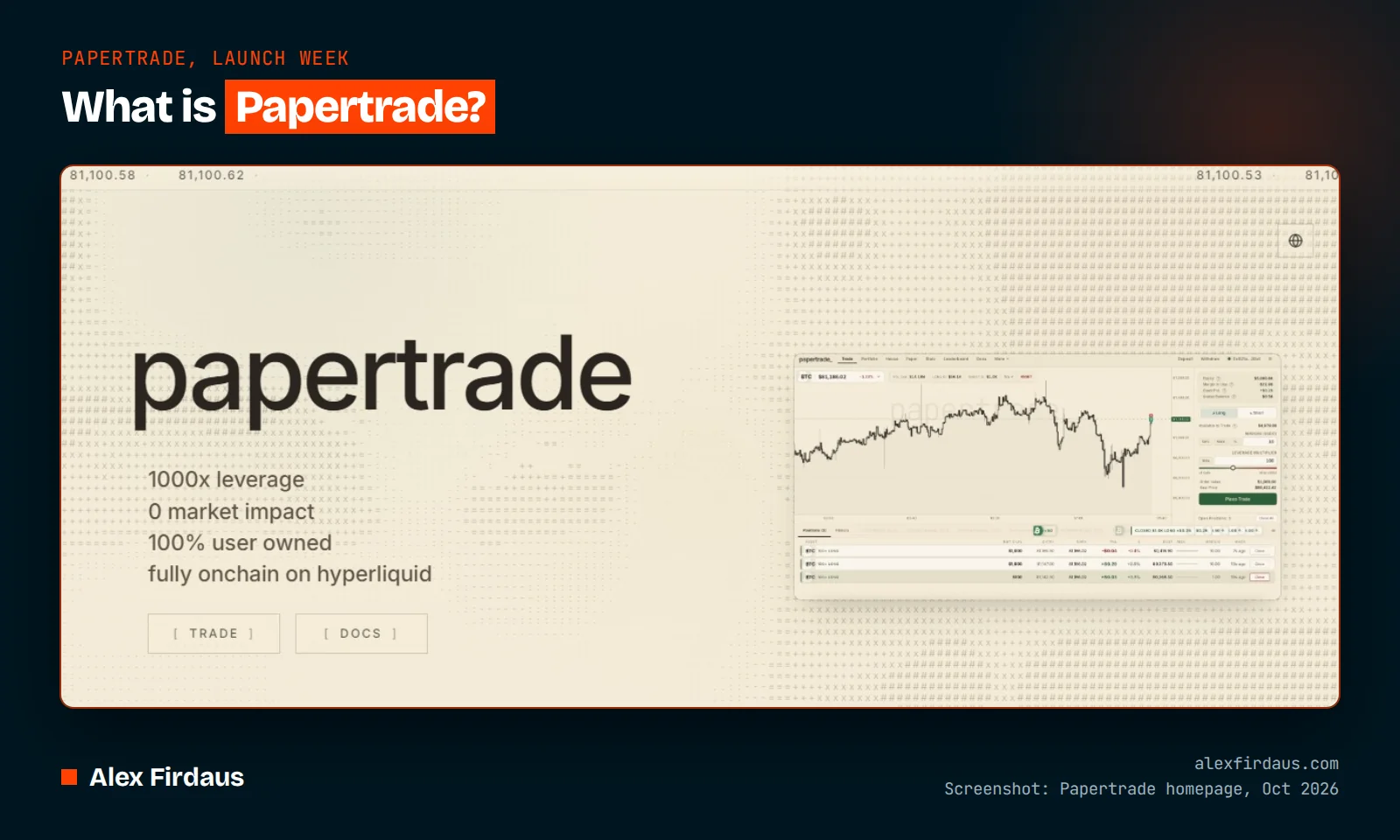
Papertrade’s homepage and trading screen, captured October 2026. The claims shown (1,000x, zero market impact, fully onchain) are Papertrade’s own.
Papertrade has no order book of its own. According to The Block’s report on the launch, Papertrade prices every trade at the midpoint of Hyperliquid’s current best bid and best offer. Keep that detail in mind. It is the weak spot in this whole story.
Papertrade charges no opening or funding fees. Papertrade takes its cut from winners only, in two ways. Winning closes pay a 2% fee on the profit, split between PAPER stakers and the developers. Winning closes also lose part of the gain to what the documentation calls an asymmetric impact haircut, and smaller price moves lose a larger share of their profit. In a worked example by Blockworks Research, a $100 win made on a 0.1% move at 1,000x leaves the trader $72.
How does Papertrade pay winning traders?
Papertrade pays winning traders out of one shared pool of USDC. The pool started at $0, accepts no outside deposits, and fills only with the money that losing traders lose.
When a trader wins and the pool cannot cover the profit, the trader still gets their original margin back straight away. Only the profit waits. Papertrade’s documentation turns the unpaid profit into a debt claim in a payout queue, and claims are paid first-in, first-out as new losses refill the pool.
Here is a simple example. A trader puts in $100 and wins $100 while the pool is empty. The $100 margin comes back at once. The $100 profit goes into the queue and gets paid when enough other traders have lost money.
The pool is also capped. Once the pool holds $5 million, extra pool gains go to PAPER stakers instead of building a bigger cushion. However busy Papertrade gets, the money standing between winners and the queue never grows past $5 million.
How does the PAPER token work?
PAPER is Papertrade’s own token, and the only way to earn PAPER is to lose money on a trade. PAPER supply started at zero, with no team allocation, no venture allocation and no airdrop. Every PAPER token in existence was minted to a losing trader.
While the pool’s tracked balance is under $2 million, every $1 lost mints 100 PAPER. After that, the rate falls as the pool’s cumulative profit grows, so later losers get fewer tokens for the same loss. Blockworks Research’s model has the rate near 30 PAPER per $1 once cumulative profit reaches $100 million. If the pool drops back under $2 million, the rate jumps back to 100 PAPER per $1.
That last rule is the clever part of the design. When the pool runs low and winners might have to queue, losing money becomes more rewarding. The higher rate pulls in exactly the losses that refill the pool.
Holding PAPER pays out in two ways. Staked PAPER earns a 1% share of realized profit and loss on settled trades, paid when the payout queue is empty and the pool can cover it. Stakers also receive pool gains above the $5 million cap. PAPER cannot be transferred between wallets at launch. Holders can only stake and unstake PAPER.
Papertrade vs a prop firm: who pays the winners?
Papertrade and a simulated-account prop firm pay winners the same way: out of money that losing traders put in. The difference is that Papertrade publishes the balance and the payout queue, while a prop firm keeps both private.
Alex Firdaus is a prop firm SEO consultant, Head of Media at FinMedia Group and lead editor at FundedTrading.com, where his coverage focuses on payout rules, drawdown and how prop firm funding models work. From the prop firm side of the industry, Papertrade reads like a prop firm with the walls taken off.
In a prop firm that runs simulated accounts, a trader pays a challenge fee to trade a demo account. A trader who passes gets a funded account, which is often still simulated (the difference between paper trading and a prop firm challenge matters here). When that trader makes a profit, the firm pays it out of its own revenue, and at most firms that run this model, the bulk of that revenue is challenge fees paid by traders who failed. Papertrade runs the same money flow with the fee step removed. Losses go straight into the pool, and wins come straight out of it.
| Simulated-account prop firm | Papertrade | |
|---|---|---|
| Who takes the other side of the trade | The prop firm | The shared USDC pool |
| Where winners’ money comes from | Firm revenue, largely challenge fees from traders who fail | Losses from other traders |
| What losing traders get | Nothing, or a discounted retry | PAPER tokens |
| When the money runs short | The firm decides privately | Winners join a public first-in, first-out queue |
| Can traders see the balance | No | Yes, live |
| Main defence against abuse | Rule pages, consistency rules and account reviews before payout | Directional position limits, a profit deadband and the haircut on wins |
Both models depend on two things: most traders lose (see what prop firm pass rates actually look like), and nobody finds a way to win that the house did not plan for. A prop firm handles the second problem quietly, with rules and account reviews. Papertrade had to handle it in public, on its first day.
How was Papertrade exploited on day one?
About eight hours after launch, one wallet took roughly $1.28 million from Papertrade’s pool. The wallet did not predict the ETH price. The wallet moved the ETH price on Hyperliquid, waited for Papertrade to copy it, and cashed out.
What the trader did, step by step
- Opened large ETH positions on Papertrade.
- Between 6:01 and 6:02 p.m. ET, bought about 6,060 ETH on Hyperliquid. The price rose about $3, or 0.12%.
- Papertrade copied the higher price, and the Papertrade positions showed a profit.
- Closed the positions on Papertrade.
- At 6:03 p.m. ET, sold about 5,210 ETH on Hyperliquid, and the price fell about $3.50.
The wallet repeated the pattern through Saturday evening. According to The Block’s review of the trading data, the wallet traded about $231 million of ETH on Hyperliquid and paid about $52,000 in trading fees. Papertrade’s own records show the wallet at $1.28 million profit on $3.18 billion of volume. The wallet withdrew about $2.48 million from Papertrade against $1.2 million deposited, including a single $1.54 million withdrawal at 6:06 p.m. ET.
X users caught it first. One user, Boblob, posted that two wallets were moving ETH on Hyperliquid with trades of about $20 million each. Another, butler, published the wallet address and a breakdown of its trades later that night.
Why did a 0.12% price move pay so much?
At 1,000x, a 0.1% price move equals the trader’s full margin. A move too small to notice on a chart is worth the entire margin of a Papertrade position, before the haircut on wins, and the trader only has to hold the price there for a minute or two.
Both founders had argued before launch that this would not pay. According to ChainCatcher, Jez said moving Hyperliquid’s quotes would take eight-figure capital, and Blurr said the pool was capped around $5 million to stay below the cost of pushing the BTC or ETH order books. The trader did use eight figures. The trader also sold almost all of it straight back, so the capital came back nearly intact. The reported cost was about $52,000 in Hyperliquid trading fees, against $1.28 million taken from Papertrade.
Papertrade’s documentation had flagged the risk before launch. Papertrade’s published risk disclosures list manipulation of Hyperliquid’s best bid and offer as an unresolved concern. The documentation says an attacker could shift the midpoint with a small limit order placed inside Hyperliquid’s spread, without the order ever filling. Papertrade lists three protections (a profit deadband, the haircut curve and directional position limits) and says none of them proves manipulation is impossible or unprofitable.
One order book is easier to push than a price built from several venues. For firms that run on the same infrastructure, see prop firms built on Hyperliquid. Hyperliquid’s own oracle price is a weighted median of prices from centralized exchanges. Papertrade used the order book midpoint instead, which is one number from one venue.
Why did Papertrade give PAPER to the trader who gamed it?
Papertrade gave PAPER to the trader because the Papertrade contract mints PAPER for every eligible loss, without checking who the trader is. When one of the trader’s attempts failed and lost about $450,000, the contract minted about 17.6 million PAPER to the same wallet.
The failed attempt went like this. At 7:13 p.m. ET, the wallet opened 30 short ETH positions at 660x, worth about $297 million in total. The wallet then sold about 6,590 ETH on Hyperliquid, pushing the price down to $2,504.40. This time the shorts stayed open for more than three hours. ETH moved back up, and the positions were liquidated at 10:31 p.m. ET at $2,509.95, for a loss of $450,000. The $1.28 million figure is the wallet’s result after that loss.
The minting rule did exactly what it was built to do. Losses refill the pool, so the contract rewards whoever refills it, without checking who is losing or why. The result: the wallet that drained the pool also received tokens that, once staked, pay a share of the pool’s future profits. What those tokens are worth is unknown, because PAPER cannot be sold or transferred yet.
What is toxic flow in prop trading?
Toxic flow is trading that keeps winning against the house because of a weakness in how the platform works, not because the trader read the market well. Prop firms and brokers that take the other side of their traders’ positions deal with toxic flow constantly.
In prop firms, the familiar forms are latency arbitrage (trading against a slow price feed), exploiting price feed errors and trading news spikes. Prop firm rule pages commonly ban or limit these, and risk teams review accounts before paying out. The detection side works on patterns across accounts, which is covered in how prop firms detect coordinated trading abuse.
Papertrade’s first day was toxic flow in its simplest form: one price source, a 1,000x multiplier, and open interest caps that were set loose for launch. In a post on X the next morning, Papertrade said the attempts were “not an oversight in the mechanism design,” that the open interest caps had been set loosely to handle launch demand, and that the caps were being tightened both onchain and at the relayer level.
How is Papertrade doing since launch?
Papertrade is still paying winners, and as of October 12, 2026, the Papertrade payout queue held zero liabilities. Activity has dropped sharply since launch day, and the PAPER mint rate has already fallen about 70% from its starting level, according to ChainCatcher’s review of Papertrade’s site and the PaperDash dashboard.
Day-one notional volume topped $678 billion, and recent 24-hour volume was about $150 billion. Total value locked had fallen to about $60.6 million, and open positions had dropped from a $3.3 billion peak to under $400 million. Each $1 lost now mints about 30.8 PAPER, against 100 at launch. PAPER stakers have collected about $26.3 million in dividends so far.
The pool held about $4.44 million, or $3.47 million after unrealized losses, while traders were net long about $114 million. A large one-sided position means a sharp ETH or BTC rally would hit the pool hard.
Papertrade says the trader later returned almost all the gains through new accounts, a claim The Block could not verify. Papertrade’s own records still show the wallet about $1.28 million ahead, with about $100 left in the account.
What are the risks of trading on Papertrade?
The main risks on Papertrade are winnings that cannot be paid right away, a price feed that can be pushed, a token with no market yet, and how fast 1,000x positions get liquidated.
Queued winnings
When the pool is short, Papertrade profit waits in the queue until new losses arrive. There is no fixed timeline for payment.
One price source
Papertrade prices trades from the midpoint of Hyperliquid’s order book. Papertrade’s own risk disclosures list manipulation of that price as unresolved.
PAPER value
PAPER cannot be transferred yet. PAPER value depends on future pool profit and on how many new tokens get minted, since every loss creates more.
1,000x liquidations
At 1,000x, a 0.1% move against the trader wipes out the margin. During the exploit, ETH moved 0.12% in about a minute.
Control is also concentrated. Per Papertrade’s launch announcement, as reported by ChainCatcher, a 2-of-3 multisig held by Jez, Blurr and UngusTrade can pause trading, freeze a market and change fee settings. Contract upgrades need a 7-day timelock. Papertrade shares a trade-off with on-chain prop firms: everything is visible, including the weak spots.
Note: Nothing on this page is a recommendation to trade on Papertrade or to farm PAPER. Papertrade figures change hourly, so check the live data before acting on any number here.
FAQs about Papertrade
Can you lose your margin if the Papertrade pool is empty?
No. A winning trader gets their original margin back when the position closes. Only the profit waits in the payout queue.
Can you sell PAPER tokens?
Not yet. At launch, PAPER can only be staked and unstaked. Transfers between wallets were disabled at launch.
Is Papertrade the same as paper trading?
No. Paper trading means practising with fake money. Papertrade is a live exchange where real USDC is won and lost against a shared pool. The paper trading vs prop firm challenge guide covers the practice-account side.
Who founded Papertrade?
Papertrade was co-founded by two traders who go by Jez and Blurr.
Did the trader who gamed Papertrade give the money back?
Papertrade says the trader returned almost all the gains through new accounts. The Block could not verify that claim, and Papertrade’s own records still show the wallet about $1.28 million ahead.