Starting a perp prop firm means choosing a platform that can run perpetual futures challenges, deciding where your price data comes from, paying traders in crypto (usually USDT or USDC), and checking where you are allowed to sell. Every perp prop firm we checked on 27 November 2026 runs its evaluations in simulation, so the real decisions are the platform, the data feed and what you do with funded traders’ positions.
This guide is for founders and existing prop firm operators adding perpetuals. We checked every vendor, firm and regulator claim between 20 and 27 November 2026, on the source’s own page where it loaded and through Finance Magnates where it didn’t (FFN Perps, ArcaTrader). Where a price or rule isn’t published, it says so.
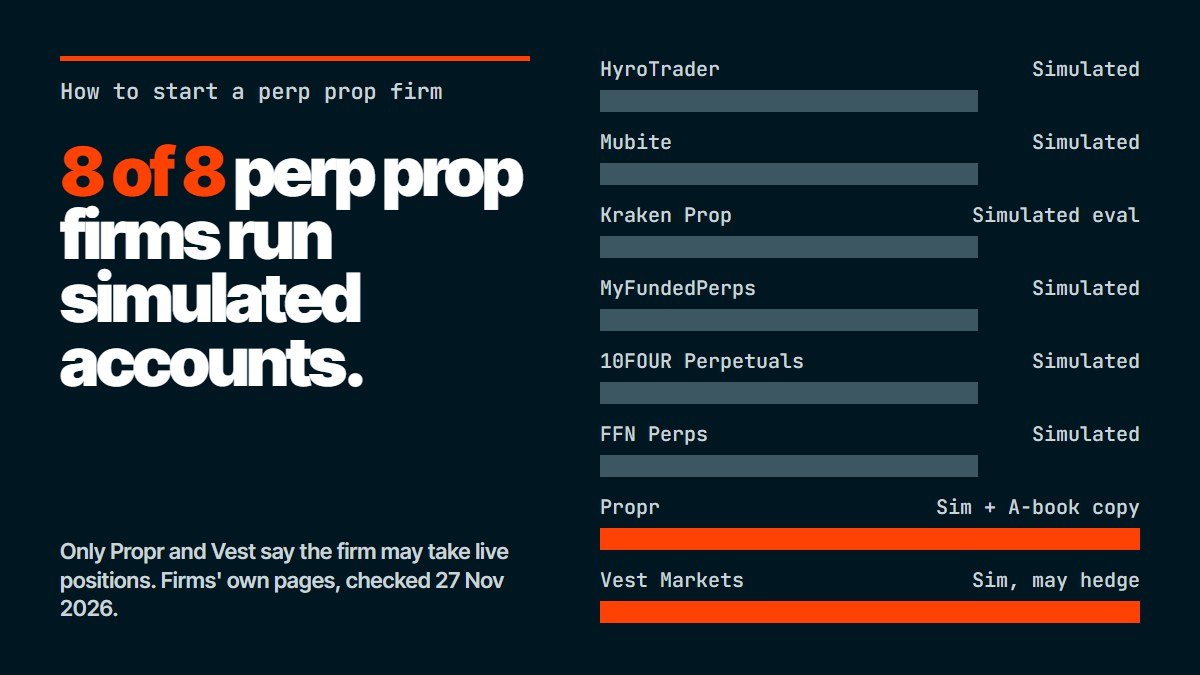
Three things stood out. Only two of eight platform vendors publish a full price. None of the eight firms we checked trades evaluation accounts live. And Bybit’s API terms ban commercial use of its data, while several firms price their challenges from Bybit demo accounts.
What a perpetual futures prop firm needs
A perpetual futures prop firm needs five things: a trading platform with perpetuals price data, a back office that runs challenges and risk rules (including spotting coordinated trading abuse), a payment rail for stablecoins, a legal entity with terms that describe simulated accounts, and a cash reserve for payouts. The first two usually come from one vendor.
The reserve is the part most launch plans skip. Perp prop firms pay out a large share of what they take in, and the perp prop firm economics guide shows the published payout data. If you’re starting from scratch rather than adding perps to an existing firm, read how to start a prop firm first.
Perp prop firm software: who sells it
Eight vendors document perpetuals or crypto prop technology a firm can launch on. Execurve and PropAccount publish full prices, Cleo publishes a monthly minimum, and B2BROKER publishes a starting price for its B2TRADER platform. The rest quote on a call.
So the shortlist you can fully price without a sales call is two names long.
| Vendor | How it runs perps | Published price | Launch time |
|---|---|---|---|
| Execurve | Own platform plus CRM and risk engine; prices and fills from your own exchange or liquidity provider, or run as a simulation. Its Starter plan covers one asset class, such as crypto | CRM from €740 a month, platform from €930 a month, up to 25% off together; €2,450 setup only with a third-party platform; no revenue share | 2 to 4 weeks (its general prop launch guide) |
| PropAccount | White label for crypto prop firms with risk engine, CRM, payments, KYC and payouts. A PropAccount blog post says firms can offer spot or perpetual contracts; its product pages list MT5, cTrader and DXtrade and don’t mention perps | Setup from $3,000, no monthly fees; White Label I pays the operator 30% of gross sales, White Label II 50% of net revenue | About 1 week |
| Trade Tech Solutions | Hyperliquid integration; says all accounts are simulated | Not published | “As little as 25 days” |
| HyroTrader Infrastructure | Simulated accounts on the trader’s own Bybit or BloFin demo account, Tealstreet or Tiger on Bybit data, or its own platform | Not published | “A few days” |
| Cleo | Prop terminal and back office with USDT-perpetual price data included | Tiered per account, with a €3,000 monthly minimum | 2 to 3 weeks from connection to live |
| ArcaTrader | Perpetuals “through Hyperliquid, Binance and Bybit” | Not published | Not published |
| B2BROKER | Its B2TRADER platform has supported perpetual futures since June 2025 and has a page for prop firms. Its B2PROP package launched on MT4, MT5 and cTrader | B2TRADER from $2,500 a month; no prop-specific price | Not published |
| Tickblaze | Platform for brokers and prop firms that lists perps and crypto among its markets, with its own risk engine and CRM | Not published | Under 30 days |
Two more options sit underneath a platform rather than replacing it. Gold-i’s MatrixNET connects to over 80 liquidity providers and 35 crypto exchanges, can simulate executions for prop firms, and integrates with Cleo. Devexperts’ DXtrade was added for Tradeify Crypto’s perpetuals traders in April 2026. Fintatech publishes prop platform prices but doesn’t mention perpetuals on its prop page, and we found no perpetuals prop product at Spencer Logic, Brokeree or Match-Trader.
How existing perp prop firms run trader accounts
All eight perp prop firms we checked say their evaluation accounts are simulated. Only two say the firm itself may take positions on a live venue.
| Firm | Price data or venue | Account model | Payouts |
|---|---|---|---|
| HyroTrader | Bybit or BloFin demo accounts, Bybit data | Simulated, “no real-capital stage at any point” | USDT or USDC |
| Mubite | Bybit and Cleo (Binance market data) | Simulated funded accounts | To the trader’s wallet; currency not stated |
| Kraken Prop (formerly Breakout) | Kraken | Evaluations simulated; Kraken calls it “an unregulated service” | Not stated |
| Vest Markets | Not stated; may hedge on Vest Exchange, an affiliated venue, or third-party venues | Virtual accounts; Vest may hedge with its own capital | USDC |
| MyFundedPerps | Hyperliquid, Binance and Bybit data | Simulated, “non-executing” | Not stated |
| Propr | Hyperliquid | Simulated; some trades copied to Hyperliquid as “A-book” | USDC, with each payout’s transaction hash published |
| 10FOUR Perpetuals | Hyperliquid data feed | Fully simulated | Within 24 hours; $25,000 lifetime cap per trader |
| FFN Perps | Unnamed third-party exchanges | Simulated | Via Rise |
Vest’s disclosures say it currently sells instant funded accounts without an evaluation, though its page also lists an evaluation.
That pattern answers the first design question. You don’t need your own exchange or liquidity to launch. You need a platform that prices simulated accounts from a public venue.
Whether you later hedge winning traders, the way Propr and Vest describe, is a risk decision. Our look at Vest Markets’ A-book claims shows how one firm describes it.
Where perp prop firms get their price data
Perp prop firms price simulated accounts from public exchange data or from exchange demo accounts. We found no prop firm program published by a major exchange, so the platform vendor connects to these on your behalf.
- Bybit runs a separate demo environment through its API. A demo account has its own user ID, keeps orders for 7 days, and its rate limit can’t be raised. Public market data on demo is the same as on the live exchange.
- OKX and Binance both document demo or testnet trading through their APIs. Neither publishes a prop firm program.
- Hyperliquid uses builder codes, which need no sign-up with Hyperliquid. Each user approves a maximum fee for the builder, the builder holds at least 100 USDC, and the fee can be at most 0.1% on perps. One operator playbook we read, Track360’s, says Hyperliquid access comes through “builder agreements”, but Hyperliquid’s own docs describe no agreement with Hyperliquid, only the user’s fee approval. Several perp prop firms and vendors build on it, as covered in our list of Hyperliquid prop firms and the wider look at on-chain prop firms.
- Kraken is the only major exchange running its own prop program, after buying Breakout. We found no Kraken prop product sold to other firms.
Some firms skip a separate platform entirely. Klein Funding asks traders to connect a Bybit sub-account demo trading API, and HyroTrader, Crypto Fund Trader and Mubite all offer Bybit as a trading option.
Check the data terms before you build on any exchange. Bybit’s API agreement says users may not commercially exploit its APIs or resell data received through them. Binance’s Vision dataset terms exclude commercial use of its historical datasets without a separate written licence. Hyperliquid’s terms say nothing on commercial data use.
How do the Bybit-based firms square that with Bybit’s terms? We don’t know. They may have a separate agreement, or the trader’s own demo account may be the workaround. We found no prop firm partner named in Bybit’s own announcements, so ask your platform vendor which exchange prices your markets and who holds the data agreement.
How perp prop firms take payments and pay traders
Perp prop firms take challenge fees in crypto, and the firms that name a payout currency use USDT or USDC. Two crypto payment processors publish rates for this, CPAY and NOWPayments.
| Processor | Published fees |
|---|---|
| CPAY | Flat 0.5% on payments, no setup fee, no monthly minimum; payouts cost network gas only |
| NOWPayments | 1% for single-currency payments, 1.5% for multi-currency; 0% on payouts |
Confirmo and Match2Pay have prop firm pages but no published rate. Confirmo claims it handles 60% of global prop trading payment flows.
Say you sell 1,000 challenges at $100 each. At CPAY’s 0.5% you pay $500 in processing. At NOWPayments’ single-currency rate of 1% you pay $1,000, and $1,500 if traders pay in several currencies.
Is a perp prop firm legal in the US?
There is no US rule that answers this directly. The CFTC has not made an official statement on the legality of prop firms, according to Finance Magnates, and the rules for perpetual futures themselves are still being set.
Gibson Dunn’s August 2026 summary lays out the steps so far. The CFTC asked for public comment on perpetuals in April 2025. On 29 May 2026 it approved Kalshi’s bitcoin perpetual contract as a futures contract and said perpetuals on assets outside that order, such as precious metals and equities, need case-by-case review. The same day, its staff let Coinbase Financial Markets offer certain perpetuals listed on Deribit.
In June 2026 CME sued the CFTC, arguing that perpetuals are swaps, not futures. Gibson Dunn’s conclusion is that the US framework “remains product- and asset-specific”.
The CFTC also charged Binance in 2023 with offering crypto derivatives to US persons without registering, and the same year settled charges against three DeFi protocols for offering illegal crypto derivatives trading.
In the EU, ESMA said on 24 February 2026 that perpetual futures with leveraged crypto exposure are likely to fall under the national CFD product intervention measures that replaced ESMA’s own. That matters if any of your accounts trade live. MiCA lists ten crypto-asset services and has no text on simulated evaluations.
Kraken describes its own prop program as an unregulated service. Execurve’s guidance is that the legal shape depends on where you incorporate and how you structure the product, and that it’s a question for a lawyer. This page isn’t legal advice.
What it costs to start a perp prop firm
Starting a perp prop firm costs a platform fee, around 0.5% to 1.5% in payment processing and a reserve for payouts. Execurve (from €740 a month) and PropAccount (setup from $3,000 plus a revenue share) publish full platform prices, and Cleo publishes a €3,000 monthly minimum. From vendors’ and processors’ own pages:
- Platform: Execurve’s CRM from €740 a month and platform from €930 a month, with up to 25% off when you take both. PropAccount’s setup starts at $3,000 with no monthly fee, then it takes a revenue share. The operator keeps 30% of gross sales (White Label I) or 50% of net revenue (White Label II). On $100,000 of challenge sales under White Label I, that’s $30,000 to you.
- Payments: 0.5% to 1.5% of challenge fees at the processors’ listed rates. NOWPayments says partners can get lower rates.
- Reserve: the money you hold back to pay traders, which the perp prop firm economics guide works through.
Trade Tech Solutions, HyroTrader Infrastructure, ArcaTrader and Tickblaze don’t publish pricing. Cleo publishes only a €3,000 monthly minimum, and B2BROKER prices B2TRADER from $2,500 a month without a prop-specific quote. Ask each for a written quote that separates setup, monthly fees and any revenue share before comparing them.
How big is the perp prop market?
No one publishes the size of the perp prop segment itself. The nearest published figures are about crypto prop payouts and perpetuals trading.
- Onchain payouts by the ten largest prop firms rose from $55.3 million in Q1 2025 to $115.1 million in Q1 2026, flat against Q4 2025, according to Finance Magnates Intelligence. That covers crypto payouts across all asset classes, not perps alone.
- Kraken Prop launched in May 2026, MyFundedFutures announced its perps brand (now MyFundedPerps) in July, FFN Perps launched in October, and Vest Labs raised a $13 million pre-seed round, as reported by Finance Magnates.
If you’re launching a perps program and need traders to find it in search and AI answers, see crypto prop firm SEO.
FAQs about starting a perp prop firm
Do I need my own exchange to start a perp prop firm?
No. Every perp prop firm we checked prices simulated accounts from public exchange data or exchange demo accounts, such as Bybit, Binance or Hyperliquid. A platform vendor connects to the data and runs the challenges.
Can a perp prop firm put traders on live accounts?
Some do, partly. Propr copies some trades to Hyperliquid as A-book, and Vest Markets may hedge with its own capital on its affiliated exchange or third-party venues. Kraken simulates evaluations but doesn’t say whether funded accounts are simulated. The other firms we checked say both evaluation and funded accounts are simulated.
How long does it take to launch a perp prop firm?
Vendors quote from a few days (HyroTrader Infrastructure) and about a week (PropAccount) to 2 to 3 weeks (Cleo) and under 30 days (Tickblaze) for the platform. Execurve’s general prop firm guide says 2 to 4 weeks. Entity setup, payments and legal review add time on top.
How much does perp prop firm software cost?
Execurve and PropAccount publish full prices. Execurve charges from €740 a month for its CRM and €930 a month for its platform. PropAccount’s setup starts at $3,000 with no monthly fee, plus a revenue share. Cleo has a €3,000 monthly minimum and B2BROKER’s B2TRADER starts at $2,500 a month. Trade Tech Solutions, HyroTrader Infrastructure, ArcaTrader and Tickblaze quote on request.
Sources, checked 20 to 27 November 2026: Execurve crypto prop firm, Execurve pricing, Execurve launch timeline, Trade Tech Solutions perpetuals, HyroTrader Infrastructure, Cleo, B2BROKER B2TRADER perpetuals, PropAccount pricing, Fintatech prop firm, HyroTrader, Mubite, Kraken Prop evaluations, Vest Markets, MyFundedPerpetuals, Propr, 10FOUR Perpetuals payout rules, Bybit demo trading API, OKX API, Binance futures API, Hyperliquid builder codes, CPAY pricing, NOWPayments fees, Confirmo prop trading, Gibson Dunn on perpetual contracts, Finance Magnates on the CFTC and prop firms, Finance Magnates on FFN Perps, PropAccount crypto prop firm, Tickblaze, Gold-i MatrixNET and Cleo, DXtrade and Tradeify perpetuals, Klein Funding Bybit, Bybit API terms, Binance Vision terms, Hyperliquid terms, ESMA statement, 24 Feb 2026, CFTC v Binance, CFTC v DeFi protocols, B2BROKER pricing, B2TRADER for prop firms, ArcaTrader (Finance Magnates, sponsored), Finance Magnates on Kraken Prop, Kraken Prop, Crypto Fund Trader, Match2Pay prop trading, Track360 operator playbook, Finance Magnates Intelligence on crypto payouts.