To start a forex brokerage you need a licensed company, a trading platform, a liquidity provider or a plan to run your own book, a CRM with payment processing, and the capital your regulator asks for. Licence fees are a few thousand dollars a year. Capital is the big number, from MUR 1,000,000 in Mauritius to €750,000 in Cyprus for a firm that trades against its clients.
This guide is for founders and operators. Every price in it was checked on 24 November 2026, on the regulator’s or vendor’s own page where one exists and in the named trade press where it doesn’t. Where nobody publishes a price, it says so.
What does it take to become a forex broker?
A forex broker needs six things before the first client deposits: a company with a dealer licence, paid-up capital, a trading platform, liquidity, a CRM and back office, and a payment provider that accepts forex. New brokers often rent the platform as a white label and buy liquidity from a prime-of-prime provider.
The order matters. The licence decides your capital, and the capital decides whether you can run a B-book at all. Pick the jurisdiction first, then the tech.
If you already run a prop firm, you have most of the tech stack and the payment headaches. My guide to starting a prop firm covers that side.
How much does it cost to start a forex brokerage?
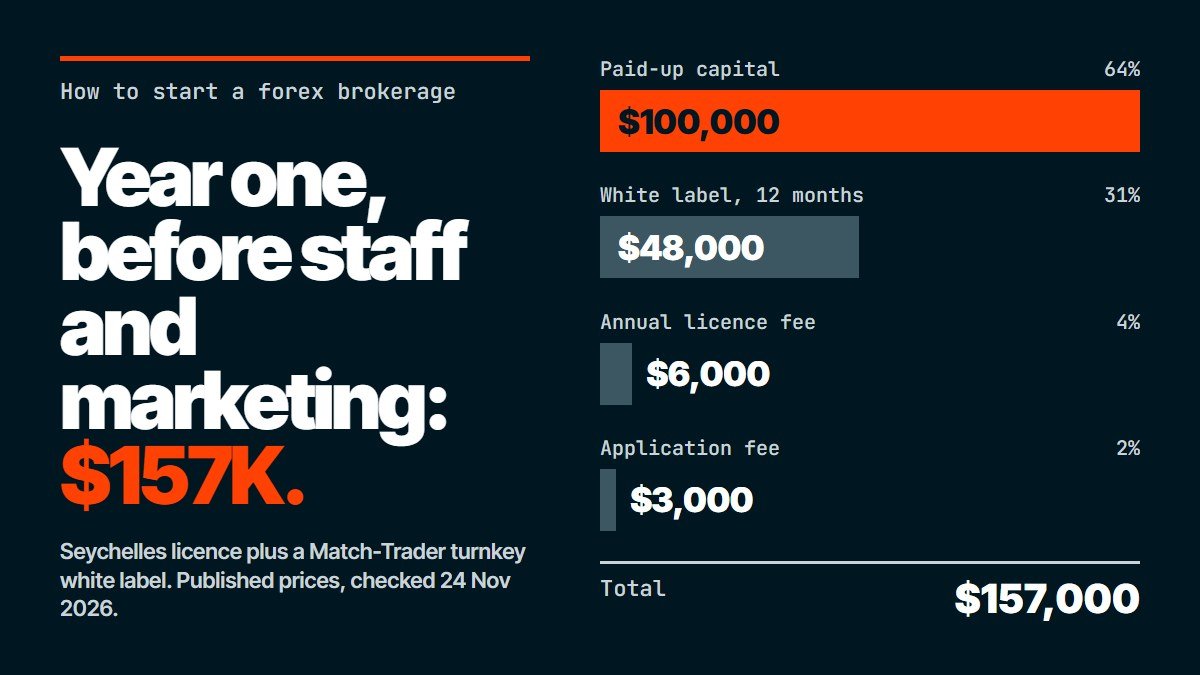
A small offshore broker in Seychelles spends about $157,000 in year one once you count capital, licence fees and a white-label platform. Mauritius can come in lower, because its capital requirement is smaller. Most of that is capital the regulator wants to see in the company. The recurring tech bill for an entry-level platform runs from €1,690 to $5,000 a month on published prices.
Here is the Seychelles example, using only published prices. Say you license in Seychelles and run Match-Trader’s turnkey white label (platform plus CRM):
| Item | Cost | Source |
|---|---|---|
| Seychelles securities dealer application | $3,000 | FSA Seychelles |
| Seychelles annual licence fee | $6,000 | 2024 fee regulations |
| Minimum paid-up capital | $100,000 | FSA Seychelles guidelines |
| Match-Trader White Label Turnkey, 12 months | $48,000 ($4,000 a month) | Match-Trade |
| Year one, before everything below | $157,000 |
That total leaves out the office and staff Seychelles requires, legal and company setup, your payment provider, audit fees and marketing. None of those have published prices I could check, so I haven’t guessed them.
The long-run version costs far more. A full MetaTrader 5 licence of your own is reported at “from $10,000 a month” by Leverate, and Finance Magnates’ industry sources put a complete MT4 package around $35,000 a month in 2025 for existing licence holders, and the same report says MetaQuotes is no longer selling new MT4 licences. MetaQuotes itself publishes no prices.
Which licence do you need for a forex brokerage?
The licence depends on who you want as clients and whether you will trade against them. Offshore licences such as Seychelles, Mauritius and Labuan cost far less in fees and capital. A Cyprus licence gets you into the EU but needs €750,000 in capital if you deal on your own account.
These are the figures from each regulator, checked on 24 November 2026:
| Jurisdiction | Application | Annual fee | Minimum capital |
|---|---|---|---|
| Mauritius (FSC), investment dealer excluding underwriting | $1,000 | $3,400 | MUR 1,000,000 |
| Mauritius (FSC), including underwriting | $3,000 | $9,500 | MUR 10,000,000 |
| Seychelles (FSA), securities dealer | $3,000 | $6,000 | $100,000 paid up |
| Labuan (Labuan FSA), money broker | $500 | $5,000 | RM 1,000,000 to 1,500,000 |
| Cyprus (CySEC), investment firm | €7,000 | €5,000 to €10,000 plus a turnover fee | €750,000 if dealing on own account |
Mauritius raised its fees on 1 July 2026. The excluding-underwriting dealer licence went from $750 to $1,000 to apply and from $2,500 to $3,400 a year. Older guides and the FSC’s pre-2026 consolidated rules still show the old numbers. The USD fees only apply to companies with a Global Business Licence, which costs another $600 to apply and $2,600 a year.
Labuan money brokers can’t run a B-book. The Labuan FSA says money broking “does not include the buying or selling of foreign currencies by the broker as a principal.” Its fees are the lowest here. Counting the $1,000 annual Labuan company fee, year one comes to $6,500, against $7,600 for Mauritius once you add the Global Business Licence. If your model depends on taking the other side of client trades, it still doesn’t fit.
Seychelles has two different annual fees on record. The 2024 fee regulations say $6,000. The FSA’s own guidelines, updated in March 2026, still say $2,500. The regulation is the legal one, so budget for $6,000. Seychelles and Labuan both publish a service standard of 30 working days from a complete application, and Labuan offers 15 working days on fast track for a $1,500 fee. In Cyprus, EU law gives the regulator up to six months.
St Vincent and the Grenadines is no longer an easy route. Since January 2023, new companies there that offer forex have to show a licence from another jurisdiction, according to local press reporting the FSA’s notice.
CySEC’s fee figures may be out of date. Its English fee text dates from 2020 and a 2023 amendment was published in Greek. A January 2026 proposal to raise the application fee to €15,000 for firms dealing on own account was reported by Finance Magnates, and we couldn’t confirm whether it has been adopted. For comparison, a UK firm dealing on own account needs £750,000 in capital and most pay an £11,260 FCA application fee.
If you’re weighing offshore entities against licensed ones, why prop firms operate offshore covers the same trade-off from the prop side.
Should you use a white label or your own platform?
Use a white label if your budget is tight, and buy your own platform if you have the money and plan to run the brokerage for years. A white label costs a few thousand dollars a month. Some vendors charge no setup fee, but MT5 and cTrader white labels usually do. Your own setup costs more but gives you control over risk, data and execution.
If you have money and you’re building for the long run, spend it on tech, and buy the best you can get. Be careful of cheaters. You need the best tools and platform to catch them.
By cheaters I mean traders who game the system: exploiting price feed delays, abusing bonuses, or running copy-trading rings.
If you have a minimum budget, go white label.
What the platforms charge, from their own pricing pages on 24 November 2026:
| Platform | Published price | Notes |
|---|---|---|
| Match-Trader white label | from $2,500 a month (Basic), $4,000 (Turnkey with CRM), $5,000 (own server) | Same tiers on its forex broker pricing page |
| TradeLocker, broker plan | $5,000 a month for 1,000 live and 2,000 demo accounts | No setup fee, billed on active accounts |
| Leverate trading platform | from €1,690 a month (1,000 accounts) to €17,800 (200,000) | No setup fee, prices excluding VAT |
| B2Broker B2TRADER | from $2,500 a month as a liquidity package | |
| cTrader (Spotware) | bundle prices listed, billing period not stated | Ask Spotware before budgeting |
| DXtrade (Devexperts) | not published | |
| MetaTrader 5 (MetaQuotes) | not published | See below |
MetaTrader is the best-known platform, and it’s the hardest to price. MetaQuotes stopped issuing new MT4 and MT5 white labels in late 2022, according to trade press at the time. FX News Group reported that MetaQuotes told partners no new white labels would be processed until further notice. New MT5 white labels now come through providers that hold a main licence. B2Broker’s blog puts them at $5,000 to $30,000 to set up and $1,000 to $10,000 a month, and Finance Magnates gives a lower setup range of $1,500 to $15,000. No provider publishes a firm price.
Should a new forex broker run an A-book or a B-book?
An A-book broker passes client trades to a liquidity provider and earns from spread markups and commissions. A B-book broker takes the other side of client trades and earns when clients lose. Some brokers run a hybrid, sending profitable traders to the A-book and keeping the rest.
Your licence decides some of this for you. A Cyprus firm that deals on own account needs €750,000 in capital instead of €150,000. A Labuan money broker can’t deal as principal at all.
The B-book is also where cheaters cost you money. A trader exploiting a price feed delay is taking money straight from your book.
How do you choose a forex liquidity provider?
Check four things before you sign with a liquidity provider: the minimum deposit or margin, the commission per million traded, which instruments they cover, and whether they connect to your platform without an extra bridge. Most providers we checked only share pricing on a sales call.
The few that publish numbers, checked 24 November 2026:
- X Open Hub (XTB): no minimum deposit and $0 volume commission on OTC instruments, for MT4 and MT5 brokers. Its site says it is moving to XTB Institutional.
- cFinancial (Spotware’s liquidity partner): a flat $4 per $1 million traded.
- B2PRIME (B2Broker): margin from 0.5%, and an “illustrative” entry tier of $8 per million.
- Finalto and XTB Institutional: no published prices.
You’ll often need a bridge to connect liquidity to the platform. B2Broker lists its B2CONNECT bridge at $1,500 a month inside its liquidity bundles.
What CRM and back office does a forex broker need?
A forex CRM handles client onboarding, KYC, deposits, withdrawals, IB commissions and the client portal. The cheapest published CRM plans run from about $500 to $2,500 a month, plus a fee on deposits with some vendors.
| CRM | Published price |
|---|---|
| B2Broker B2CORE | $1,000 a month (Starter) to $20,000 (Enterprise), plus 1.00% to 0.10% on deposits above the included amount, 3-month minimum |
| Leverate CRM and client portal | €2,390 a month, no setup fee |
| UpTrader | from $500 a month for 0 to 30 traders, no setup fee |
| FXBO | not published |
Card and bank processors for forex rarely publish prices. Crypto processor Match2Pay advertises no setup fee but says its processing fees are negotiable. Leverate charges €750 to integrate each new payment provider into its CRM.
How do forex brokers make money?
Forex brokers earn from spread markups, commissions per lot, swap charges on overnight positions and, on the B-book, client losses. New brokers also pay commissions to the introducing brokers and affiliates who bring in clients.
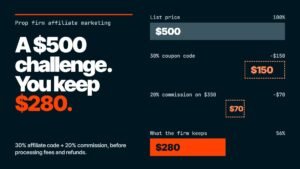
IB commissions work like affiliate commissions at a prop firm, and the same problems show up: partners who don’t promote, fake audiences, and commission on traders who would have come anyway. I covered how to set those deals in prop firm affiliate marketing.
How do you get your first traders?
New forex brokers get their first traders through introducing brokers, affiliates, paid ads where they’re allowed, and search. Search is slower to start but cheaper per trader once your pages rank, because you don’t pay a commission on every client it brings in.
Google allows forex and CFD ads only in some countries and only after advertiser certification. Meta’s ad rules list CFD trading among the financial products ads can’t promote. Check both before you plan a launch around paid ads. If you want search working from day one, start with the forex keywords your clients actually type, and see how I approach SEO for forex brokers and forex broker marketing.
FAQs about starting a forex brokerage
How much does it cost to start a forex brokerage?
Using Seychelles as the example, a small offshore forex brokerage needs about $157,000 in year one before staff, office and marketing. That covers $9,000 in licence fees, $100,000 in capital and a $4,000-a-month white label (prices checked 24 November 2026). Mauritius can come in lower because its capital requirement is MUR 1,000,000. A Cyprus broker that deals on own account needs €750,000 in capital alone.
What is the cheapest forex broker licence?
On published fees, Labuan is the cheapest of the licences checked. It costs $500 to apply, $5,000 a year and a $1,000 annual company fee, or $6,500 in year one, but its money brokers can’t trade as principal. Mauritius costs $1,000 to apply and $3,400 a year for an investment dealer excluding underwriting, plus $600 and $2,600 for the Global Business Licence.
How long does it take to get a forex broker licence?
Seychelles and Labuan both publish a service standard of 30 working days from a complete application, and Labuan offers 15 on fast track. In Cyprus, EU law gives the regulator up to six months. Mauritius doesn’t publish one in the documents we checked.
Can you start a forex brokerage without a licence?
It’s a serious risk, and one of the old routes has closed. St Vincent and the Grenadines now asks new forex companies to show a licence from another jurisdiction. Some founders start as an introducing broker for an existing licensed broker instead.
Can you still get a MetaTrader 5 white label?
Yes, but not directly from MetaQuotes. MetaQuotes stopped issuing new white labels in late 2022, according to trade press, so new MT5 white labels come through providers that hold a main licence. Published market ranges run from $1,500 to $30,000 to set up and $1,000 to $10,000 a month.
Sources, all checked 24 November 2026: FSC Mauritius fee rules (GN No. 119 of 2026), FSC Mauritius Securities (Licensing) Rules 2007, Seychelles S.I. 120 of 2024, FSA Seychelles Securities Dealer Guidelines (March 2026), Labuan FSA fee schedule, Labuan FSA client charter, Labuan IBFC on money broking capital, Finance Magnates on CySEC fees, MiFID II (Directive 2014/65/EU), FCA MIFIDPRU 4.4, Google Ads financial services policy, Meta prohibited financial products policy, UpTrader pricing, Match2Pay, Labuan FSA money broking, CySEC fee directive DI87-03, EU Directive 2019/2034, FCA authorisation fees, Match-Trader broker pricing, TradeLocker broker pricing, Leverate platform pricing, Leverate MetaTrader and CRM pricing, B2CORE pricing, B2Broker liquidity bundles, B2Broker on MT5 white-label costs, Finance Magnates on MetaTrader fees, Finance Magnates on white-label prices, FX News Group on MetaQuotes white labels, Spotware bundle, X Open Hub liquidity, B2PRIME liquidity, Searchlight on SVG forex licensing.