Prop firm affiliate marketing is how a prop firm pays creators, review sites and community owners a cut of the challenges their audience buys. This guide is for operators building or fixing a program, not for affiliates looking to join one.
Disclosure: I am Head of Media at FinMedia Group and editor-in-chief of FundedTrading.com, a prop firm comparison site that earns affiliate commissions from prop firms. So I have a stake in how firms treat affiliates. Commission terms below were checked on each program’s own page on 24 November 2026.
How prop firm affiliate commissions work
A prop firm affiliate gets a percentage of the challenge fee when a trader buys through their link or coupon code. Most programs pay between 10% and 20%, tracked by a cookie, a code, or both.
The headline rate is the least interesting part of the deal. Three terms decide what the program actually costs you:
- Which purchases pay. First purchase only, every purchase, or a lower rate on repeats.
- How codes are tracked. Whether a coupon sale counts forever or only inside the cookie window.
- What doesn’t pay. Resets, refunds and chargebacks.
Here is how three live programs set those terms, checked on each program’s own page on 24 November 2026:
| Program | Rate | Repeat purchases | Coupon codes |
|---|---|---|---|
| Goat Funded Trader | 12%, rising to 15% after 100 referred customers, plus 5% on sub-affiliates | Paid within a 30-day cookie; resets earn nothing | Up to 5 codes, up to 40% off; coupon sales count even after 30 days |
| One Stop Prop | 12%, 15% or 20% by tier | First qualifying purchase of a new customer only | Exclusive code per partner |
| Crypto Fund Trader | 10% to 18% on a new customer’s first purchase, by tier | 5% to 8% when an existing trader reuses the code | Custom code at 10% off |
Why firms are moving to first-purchase commissions
More firms now pay affiliates on a trader’s first purchase only, or pay much less on repeats. The reason is that most traders buy again, and they keep using the same code.
A trader who fails a challenge usually buys another one. If they used an affiliate’s code the first time, they’ll often use it the second, third and fourth time too. Under a lifetime commission, you keep paying the affiliate for a customer who already knows your firm and would probably come back anyway.
Firms want affiliates to bring in new traders. Paying only on the first purchase, or paying much less on repeats like Crypto Fund Trader does, is how they make the affiliate’s money depend on that.
How much this changes the affiliate’s income depends on how often traders rebuy. Track360, which sells affiliate tracking software, estimates that repeat purchases make up 55% to 65% of challenge revenue and that about 60% of programs now pay something on repeats. Those are a vendor’s estimates, not audited figures, but the direction matches what I see.
Not every firm is cutting back. Someone who runs one of the biggest prop firms told me they got affiliates wrong early on by not focusing on them, lost out because of it, and are now putting real effort into affiliates.
A first-purchase-only program is cheaper to run, but it’s less attractive to good affiliates. From the affiliate side, working with these firms isn’t worth it unless the first-purchase rate is good enough to make up for the repeats they lose. If you cut repeat commissions, expect to pay more on the first sale.
How to set your commission and coupon discount
Start with a fair commission, not the highest one in the market. The commission and the coupon discount come out of the same challenge fee, so set them together.
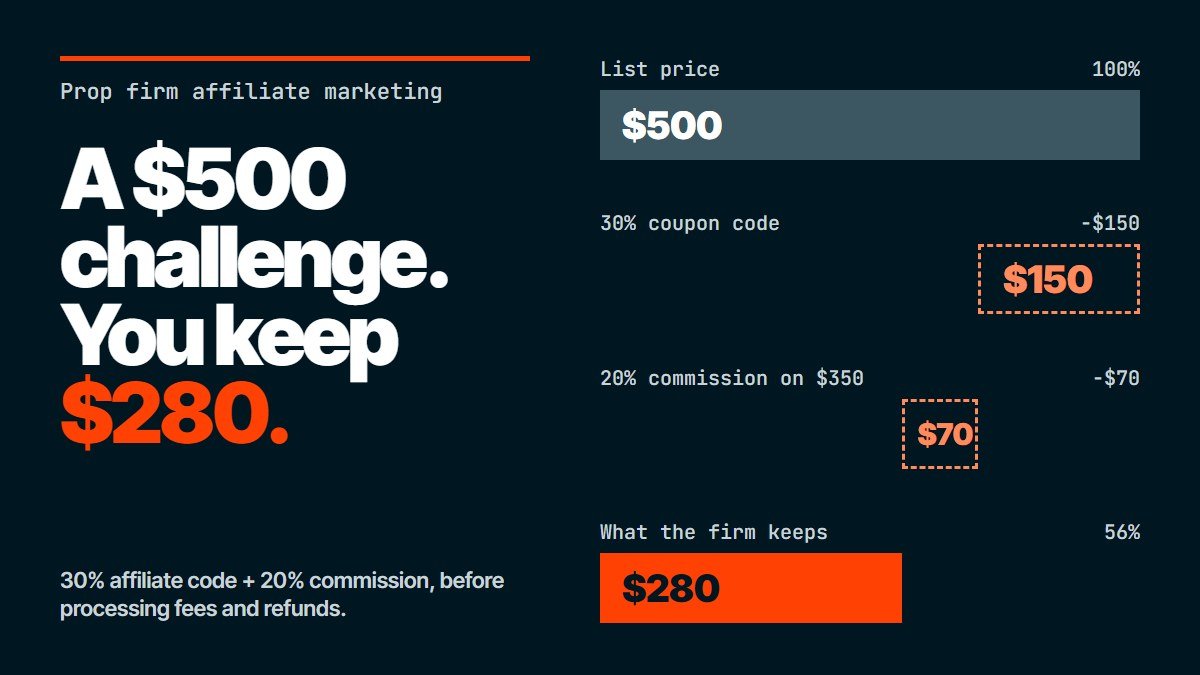
Almost every serious affiliate will ask for a custom code. That code gives their audience a discount, and you pay the commission on top of it. Here is what that looks like on a $500 challenge with a 30% code and a 20% commission, assuming commission is paid on what the trader actually pays:
| Amount | |
|---|---|
| List price | $500 |
| Trader pays after 30% code | $350 |
| Affiliate commission at 20% | $70 |
| What the firm keeps | $280 |
The firm keeps 56% of the list price before payment processing fees, payouts and refunds. That’s tight. A 20% commission and a 30% code look fine on their own and squeeze your margin when you add them up.
So decide your floor first: the lowest share of list price you’ll accept on an affiliate sale. Then split what’s left between commission and discount. If a big affiliate wants a deeper code, you can give it to them and lower the commission, or keep the commission and cap the code.
Who to recruit as affiliates
Work with established names in the industry: review sites, educators and communities with a real track record. Follower counts tell you very little in this niche.
Review and comparison sites. Listing sites such as FundedTrading compare firms side by side. A listing on one with a good reputation is a backlink to your firm, and it puts you in front of traders who are comparing firms right now. That’s worth something even before the first sale. It’s the same reason review sites so often outrank a firm’s own brand name in Google.
Educators and communities. Trading educators, YouTube channels and Discord groups can sell a lot of challenges, but only if the audience is real. Check before you agree to anything (see the next section).
Prop firm expos. I’d avoid them. If something happens and the organisers stop liking you, they can take you down, and whatever you paid for goes with it.
How affiliates take advantage of prop firms
The common abuses are affiliates who take free accounts and never promote, audiences made of bots, and giveaways where the prizes go to the affiliate’s own people.
These are the patterns I see most:
- Account collectors. Someone asks for free challenge accounts “to review” or “to show my audience,” then posts nothing or one story that disappears in a day.
- Fake audiences. High follower counts that turn out to be mostly bots. The engagement looks fine until you check who is liking and commenting.
- Rigged giveaways. The affiliate runs a giveaway with your accounts, pumps it with fake engagement, then gives the winning accounts to their own people or sells them to their community.
- Self-referral. The affiliate buys through their own code to collect commission on their own purchases. Ban it in your terms, including purchases from anyone in the affiliate’s household.
- Cookie stuffing. Dropping an affiliate cookie on visitors who never clicked a link, so the affiliate gets credit for sales they didn’t drive. I wrote about a case of this involving PropFirmMatch.
What helps: don’t hand out free accounts before you’ve seen real promotion, ask for audience analytics rather than screenshots of follower counts, pay giveaway prizes only to winners you can verify, reverse commission on refunds and chargebacks, and write your terms so you can withhold commission while you investigate.
Affiliates or SEO: which brings in traders more cheaply
Affiliates can bring in a lot of traders, but every one of those sales costs you a commission. SEO is cheaper per trader once your pages rank, because you don’t pay for each sale.
Traders search for coupon codes even when they find you through Google. If the code they find belongs to an affiliate, you still pay that affiliate’s commission on a sale your own search traffic brought in.
You don’t have to choose one channel. Affiliates get you in front of traders who don’t know you yet. Search catches traders who are already looking. If you want to compare the cost of each channel properly, start with your cost to acquire a trader, and see how I approach prop firm marketing across channels.
FAQs about prop firm affiliate marketing
What commission do prop firm affiliate programs pay?
Most prop firm affiliate programs pay 10% to 20% of the challenge fee. Goat Funded Trader pays 12% to 15%, One Stop Prop pays 12% to 20% by tier, and Crypto Fund Trader pays 10% to 18% on a first purchase and 5% to 8% on repeats (checked 24 November 2026).
Should a prop firm pay commission on repeat purchases?
It depends on whether you want affiliates to bring new traders or to keep earning from existing ones. Paying only on the first purchase cuts your cost, but good affiliates will expect a higher first-sale rate in return.
Do affiliate coupon codes cut into a prop firm’s margin?
Yes. The discount and the commission both come out of the challenge fee. A 30% code plus a 20% commission leaves a firm about 56% of the list price before fees and refunds.
How do prop firms stop affiliate fraud?
Ban self-referrals, reverse commission on refunds and chargebacks, check audience analytics before giving free accounts, and keep the right to withhold commission during an investigation.
Is affiliate marketing better than SEO for a prop firm?
Affiliates bring traders faster, but you pay for every sale. SEO costs less per trader once pages rank. Most firms use both, and the start-a-prop-firm cost breakdown shows where each fits in a launch budget.