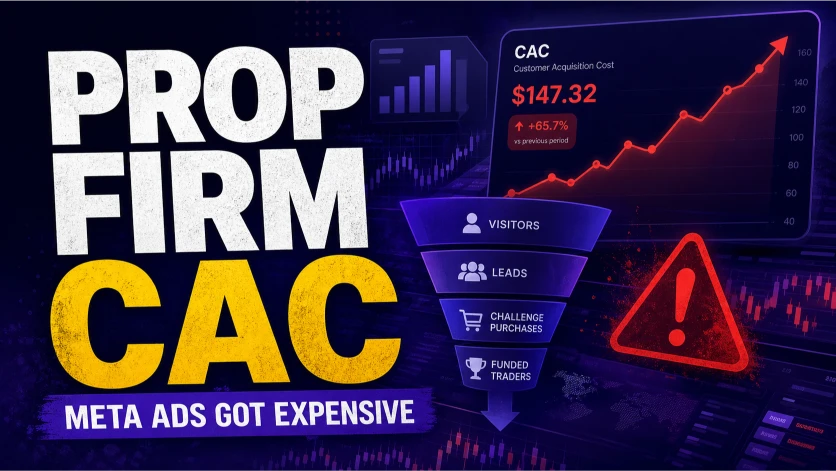
Prop firm CAC is getting harder to control because Meta now rewards clean conversion data, broad delivery, compliant creative, and purchase-based optimization. Firms still optimizing for cheap leads, manual targeting, or hype-heavy ad copy are paying more for lower-quality acquisition.
What Is Prop Firm CAC?
Prop firm CAC is the cost to turn a cold trader into a paying customer, usually through a challenge purchase, instant funding sale, or funded account upgrade. Clicks, leads, and Discord joins are not CAC.
That distinction matters because prop firms love fake numbers.
A campaign can show:
- Low CPM
- Cheap leads
- High click-through rate
- Lots of abandoned checkout traffic
None of that means the firm acquired a customer.
Real CAC is measured against revenue events. For prop firms, that usually means a trader buys a challenge, purchases an instant funding account, renews after failure, or moves into a higher-value account tier.
If your agency reports “cost per lead” but cannot show cost per challenge purchase, they are measuring noise. Nice-looking noise, but still noise.
The same test applies to any marketing agency for forex brokers: the report has to show live accounts funded, not leads, or it is not a CAC report.
Why Is Prop Firm CAC Rising on Meta?
Prop firm CAC is rising because Meta has pushed advertisers toward automation while financial advertisers face tighter policy review, weaker manual targeting control, and higher competition for traders who actually buy.
Meta’s Advantage+ system is now central to campaign setup. In 2025, Meta reported that Advantage+ Shopping Campaigns grew 70% year over year in Q4 2024. Early Advantage+ lead tests also reduced cost per lead by 10% on average in tests run from November 2024 to January 2025.
That sounds lovely until your funnel feeds Meta bad signals.
If you optimize for leads, Meta finds leads. If you optimize for purchases, Meta finds buyers. If you optimize for “people who click trading ads and never buy anything,” congratulations, you built a donation system for Menlo Park.
Paid acquisition also gets more expensive when it carries the whole growth plan. Meta can generate demand, but it should not be the only channel feeding trader acquisition. A stronger prop firm marketing strategy spreads growth across paid ads, SEO, email, affiliates, and brand search.
For prop firms, CAC rises when campaigns optimize for the wrong event. Lead forms, quiz opt-ins, Telegram joins, and coupon hunters are easy to generate. Funded account buyers are harder.
Why Does Manual Targeting No Longer Fix Prop Firm CAC?
Manual targeting no longer fixes prop firm CAC because Meta’s delivery system has shifted toward broad, signal-led optimization. Narrow audiences often restrict learning instead of improving buyer quality.
Old prop firm ad setups relied on trader interests, influencer audiences, lookalikes, and stacked exclusions. That worked better when platform targeting carried more of the load. Now the platform wants volume, conversion data, creative variety, and fewer restrictions.
That does not mean “let Meta do everything and pray.” It means the control point moved.
You control
- The conversion event
- The offer structure
- The landing page
- The creative angles
- The compliance boundaries
- The post-purchase tracking
You don’t win by obsessing over
- Which placement an ad appears in
- Manual interest stacking
- Lookalike audience sizes
- Exclusion layer complexity
Meta’s Advantage+ placements are designed to increase reach and lower cost per result across Facebook, Instagram, Messenger, Reels, Stories, and Audience Network. The real question is whether “cost per result” means anything useful in your account.
Which Metrics Actually Matter for Prop Firm CAC?
The metrics that matter for prop firm CAC are cost per challenge purchase, cost per funded account, refund rate, repeat purchase rate, payout liability, and net revenue per acquired trader.
A cheap trader is not automatically a good trader. A costly trader is not automatically bad either.
| Metric | Why It Matters |
|---|---|
| Cost per challenge purchase | Shows paid acquisition cost against real revenue |
| Cost per instant funding sale | Separates higher-ticket buyers from low-intent leads |
| Refund rate | Reveals weak traffic, bad sales pages, or misleading ads |
| Repeat purchase rate | Shows whether failed traders buy again |
| Funded account rate | Measures the quality of traders entering the system |
| Payout liability | Keeps ad scaling tied to operational risk |
| Net revenue per trader | Shows whether CAC is profitable after fees and payouts |
Most prop firms overfocus on front-end sales. That is lazy math.
If a trader buys once, fails, never returns, and came through a discount-heavy ad, the CAC ceiling is low. If a trader buys multiple evaluations, upgrades account size, or becomes a long-term brand advocate, the firm can pay more to acquire them.
That is why prop firm CAC is not just an ad metric. It is a business model metric.
How Do Meta Policies Affect Prop Firm CAC?
Meta policies increase prop firm CAC when ads trigger financial product restrictions, personal attribute rules, unrealistic claims, or prohibited trading language. Rejections slow testing and push campaigns back into learning.
Prop firms sit in an awkward category. You are not a broker in the classic sense, but you are still advertising a trading-related product. That means your copy has to avoid anything that implies guaranteed income, financial rescue, or speculative trading promises.
Meta’s prohibited financial products policy covers products associated with deceptive promotion, including binary options, ICOs, and CFD trading. Even when a prop firm is selling an evaluation rather than direct CFD access, sloppy copy can drag the ad into the wrong review bucket.
Avoid claims like
- “Guaranteed payout”
- “Quit your job with trading”
- “Instant funding with no risk”
- “Struggling trader? Get funded today”
- “Make $10,000 this month”
Use safer framing
- Evaluation rules
- Account sizes
- Trading conditions
- Payout process
- Risk controls
- Platform requirements
Compliance is not boring. Losing your ad account is boring. Also expensive.
How Should Prop Firms Lower CAC?
Prop firms lower CAC by optimizing for paid buyers, feeding Meta clean purchase signals, testing compliant creative at volume, and matching campaign structure to the firm’s actual revenue model.
Start with the event. If the goal is challenge sales, optimize for challenge purchase. If the goal is instant funding, optimize for instant funding purchase. If the goal is high-value repeat buyers, build audiences from real customer data rather than lead magnets and giveaway hunters.
Then fix the offer. Prop firms often use discounts as a crutch. A discount can work, but it also attracts traders who shop by coupon instead of rules, payout reliability, or platform quality.
Better ad angles include
- Clear evaluation rules
- Transparent payout terms
- Account size comparisons
- Platform and instrument access
- Risk limits
- Trader support
- Challenge difficulty
Creative still matters because Meta needs strong inputs before automation can find winners. If your ads all use the same discount hook, stock trader image, and “get funded fast” angle, fix your prop firm ads strategy before blaming the algorithm.
Meta’s Advantage+ creative tools are built to generate and personalize ad variations across placements. That does not mean you let Meta write your entire brand voice — it means you give the system enough clean inputs to test. Feed it five weak ads and you get five weak ads with automation sprinkled on top.
What Should Prop Firm Owners Stop Doing?
Prop firm owners should stop judging Meta campaigns by cheap leads, manual audience tricks, vanity engagement, and “one winning ad” fantasies. CAC only improves when the funnel teaches Meta what a valuable trader looks like.
Stop doing this
- Optimizing for leads when you need purchases
- Sending cold traffic to weak homepages
- Running hype copy that triggers review
- Measuring CTR instead of CAC
- Testing one creative angle at a time
- Blaming broad targeting for a bad funnel
- Letting affiliates and agencies report vanity numbers
The painful truth is simple. Meta does not know your business model unless your tracking tells it. If your pixel sees junk leads, it finds junk leads. If your CRM sends back purchase quality, refund data, and repeat buyer value, the system has something useful to work with.
Final Takeaway
Prop firm CAC is no longer a simple ad-buying problem. It is a data, compliance, creative, and funnel problem sitting inside one number.
The firms that win will not be the ones shouting “get funded fast” the loudest. They will be the ones tracking real buyers, writing compliant ads, testing more creative, and letting Meta optimize toward revenue instead of noise.
Paid ads can scale fast, but organic demand lowers blended CAC over time. That is where prop firm SEO becomes useful: it captures traders researching reviews, rules, payouts, and alternatives before they ever click an ad.
If you are weighing that against ad spend, the other half of the sum is what SEO costs to run. That is on my prop firm SEO pricing page.
Meta changed the game. Prop firms can complain, or they can fix the scoreboard.
A rising CAC is usually a symptom, and the cause normally sits upstream in positioning and retention. That is covered under prop firm marketing.
Ready to lower your prop firm CAC?
Get content strategy and SEO built for prop firms, so traders find you before they click a competitor’s ad.
Get in touch →FAQ
What is a good CAC for a prop firm?
A good prop firm CAC depends on challenge price, repeat purchase rate, refund rate, and payout liability. A $60 CAC can be terrible on a low-ticket offer, while a $150 CAC can work if buyers repeat or upgrade.
Should prop firms optimize Meta ads for leads or purchases?
Prop firms should optimize for purchases once they have enough conversion volume. Lead optimization attracts cheaper volume, but it often fills the funnel with traders who never buy.
Are Meta ads still worth it for prop firms?
Meta ads are still worth it for prop firms with compliant creative, clean tracking, and a strong offer. Firms relying on hype copy, weak landing pages, and lead-only reporting usually overpay. Fixing the words is what financial copywriting is for.
Why do prop firm ads get rejected?
Prop firm ads get rejected when they imply guaranteed income, target personal financial struggles, use misleading trading claims, or resemble prohibited financial products. Copy needs to focus on rules, process, and evaluation terms.
How can SEO reduce prop firm CAC?
SEO reduces blended prop firm CAC by capturing traders before they enter paid ad retargeting pools. Pages about rules, reviews, payouts, comparisons, and account types can bring in demand without paying for every click.
[ work with me ]
Services
Prop firm SEO, broker SEO, AI Overview optimisation, and audits. One industry, on purpose.