Prop firm ads work when the creative, offer, landing page, and compliance are built around how traders actually decide. The goal is not more clicks. The goal is attracting better challenge buyers, improving ROAS, and avoiding the usual funded trader acquisition traps.
Prop firm ads are not hard because traders are impossible to reach. They are hard because every firm is shouting the same thing.
“Get funded fast.”
“Trade our capital.”
“Limited-time discount.”
Lovely. Very original. Put it next to a stock photo of a man staring at candlesticks and you have half the industry’s ad strategy.
The problem is not just weak copy. It is weak positioning, lazy creative testing, unclear landing pages, and a poor understanding of trader psychology.
Most prop firms treat paid ads as a money tap. They launch Meta campaigns, target traders, add a discount code, and wait for challenge purchases. Then CAC rises, ROAS drops, and everyone blames the algorithm.
The algorithm is not your biggest problem. Your ads are.
Why this matters: NCSolutions and Nielsen’s 2023 analysis of nearly 450 campaigns found creative was the largest contributor to short-term sales lift, at 49%, ahead of brand, reach, targeting, and recency (Marketing Charts). That does not mean targeting is irrelevant. It means your creative gives the platform better or worse signals.
If your ad is bland, your data is bland. If your offer is unclear, your learning phase gets messy. If your landing page does not match the ad, your conversion rate quietly dies.
What are prop firm ads?
Prop firm ads are paid campaigns that promote trading challenges, funded accounts, payout offers, trader evaluations, discounts, or acquisition funnels for proprietary trading firms. The best ones sell the opportunity clearly without promising profits, instant funding, or risk-free trading.
A prop firm ad is not the same as a normal ecommerce ad. You are not selling shoes, meal kits, or a neck pillow with suspiciously emotional testimonials. You are selling access to a rule-based trading challenge where the buyer may fail.
That changes the strategy.
Good prop firm ads need to handle five jobs at once:
- Get attention from traders
- Explain the challenge offer quickly
- Reduce trust friction
- Stay inside platform and regulatory limits
- Push the trader to the right next step
That next step could be a challenge purchase, account comparison page, WhatsApp conversation, webinar, or retargeting sequence.
Bad prop firm ads skip the thinking and go straight for the fantasy.
“Pass today.”
“Get $100K instantly.”
“No risk.”
Important: That may get clicks, but it can attract low-quality buyers, increase complaints, and create compliance risk. Meta says its ad review can include images, video, text, targeting information, and the destination page, such as a landing page or website (Meta ad review). So the ad is not the only thing being judged. The page behind it matters too.
Why do most prop firm ads fail?
Most prop firm ads fail because they copy competitor offers instead of building a clear acquisition system. The creative looks generic, the discount has no strategy, the landing page lacks trust, and the campaign measures clicks instead of profitable trader revenue.
The average prop firm ad has three problems. First, the creative is interchangeable. Remove the logo and nobody can tell which firm posted it. Second, the offer is thin. A discount code alone is not positioning. Third, the funnel is incomplete. The ad gets attention, then sends the trader to a generic homepage packed with choices, friction, and no clear path forward.
This is why prop firm ads should sit inside a broader prop firm marketing strategy, not operate as a random traffic source.
| Funnel stage | Trader mindset | Best ad angle | Best CTA |
|---|---|---|---|
| Awareness | “Can I actually get funded?” | Lifestyle, proof, trader identity | Learn how it works |
| Consideration | “Which firm should I trust?” | Rules, payouts, account comparison | Compare challenges |
| Conversion | “Is now the right time?” | Discount, urgency, clear terms | Start challenge |
| Retargeting | “I almost bought.” | Objection handling, second chance | Claim offer |
If you use the same ad for every stage, you are forcing one creative to do four jobs. That usually ends badly.
What makes traders click prop firm ads?
Traders click prop firm ads when the ad speaks to their ambition, competitiveness, doubt, and price sensitivity. The strongest ads combine a fast hook, believable proof, clear offer mechanics, and a CTA that matches the trader’s stage of awareness.
Traders are often skeptical, opportunity-driven, competitive, and sensitive to unclear rules. They want upside, but they also know there is usually a catch. Your creative has to respect that tension.
| Angle | Example hook | Why it works |
|---|---|---|
| Freedom | Trade bigger without needing your own $100K. | Sells the desired outcome |
| Challenge | Think you can pass a funded account test? | Triggers competitiveness |
| Proof | Real payout. Real trader. Clear rules. | Reduces skepticism |
| Discount | 20% off your next challenge today. | Lowers purchase friction |
| Rules clarity | Check the drawdown rules before you buy. | Builds trust |
Example angle mix
- Awareness ad: Most traders do not need more leverage. They need clear rules.
- Consideration ad: Before you buy a challenge, check the drawdown terms.
- Conversion ad: 15% off $50K and $100K challenges this week.
- Retargeting ad: Still comparing firms? Here are the rules traders ask about first.
That is a system. Not random ads with budget attached.
Which creative formats work best for prop firm ads?
Short-form video, Reels, Stories, testimonial clips, founder videos, screen recordings, and simple offer images can all work for prop firm ads. The format should match the message: video for proof, image for discounts, and carousel for rule breakdowns.
Creative quality is still one of the biggest drivers of ad performance. The NCSolutions and Nielsen 2023 analysis found creative contributed 49% of short-term sales lift across the campaigns studied, more than targeting or reach alone (Marketing Charts).
That does not mean your prop firm needs a cinematic ad with slow-motion traders and dramatic music. Please, spare everyone.
It means the ad needs a strong idea.
| Format | Best use | Example |
|---|---|---|
| UGC video | Trust and proof | Trader explains the challenge experience |
| Founder video | Credibility | Founder explains payout or drawdown rules |
| Screen recording | Product clarity | Walk through dashboard or challenge page |
| Static image | Fast promo | 20% off $100K challenge |
| Carousel | Education | Step-by-step challenge rules |
| Reels or Stories | Native attention | Fast hook with captions |
Simple UGC script
- Hook: I nearly skipped this prop firm because the rules looked strict.
- Context: Then I checked the drawdown and payout terms.
- Proof: Here is what made it different.
- CTA: Compare the challenge before the promo ends.
No fake luxury car. No rented office. No “this changed my life” unless the claim is real and you can support it.
How should prop firms use discounts in ads?
Prop firms should use discounts strategically, not constantly. The best discount ads target specific moments such as a first purchase, failed challenge retry, seasonal promo, bundle offer, regional campaign, or checkout recovery.
Discounts can work because many challenge buyers compare firms, test multiple account sizes, or return after failing. That makes second-chance offers especially useful. But discounting without structure can damage the funnel and train the audience to wait for the next promo.
| Discount type | Best audience | Example |
|---|---|---|
| First challenge discount | Cold buyers | Start your first challenge with 15% off. |
| Retry discount | Failed challenge users | Retry your challenge with 20% off. |
| Bundle offer | Repeat buyers | Buy two challenges and save. |
| Regional promo | Price-sensitive markets | Local market promo this week. |
| Cart recovery | Abandoned checkout | Your challenge discount expires tonight. |
If the only reason traders buy from you is because you are cheaper today, you do not have a brand. You have a sale sign.
How do you test prop firm ad creative?
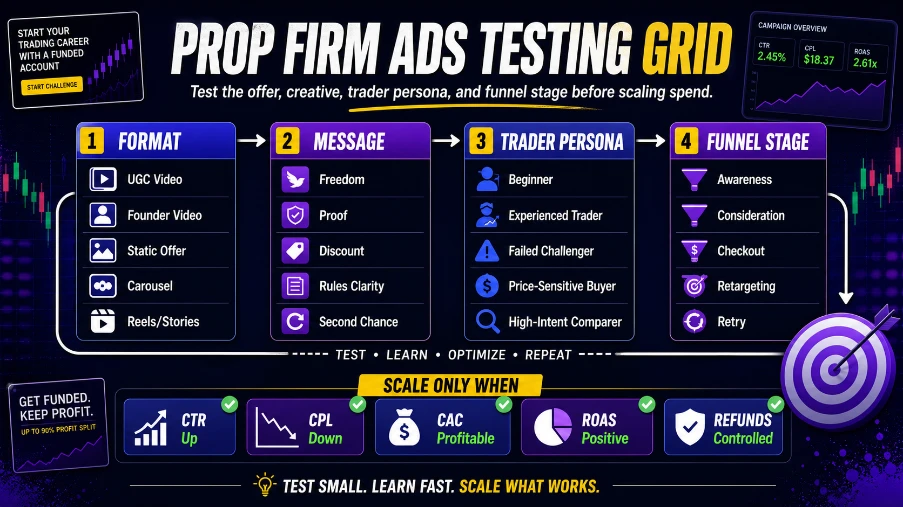
Test prop firm ad creative by separating format, message, persona, and funnel stage. Start with controlled tests, measure CTR, CPL, checkout conversion rate, CAC, ROAS, refunds, and chargebacks, then scale the combinations that produce profitable revenue.
Most prop firms test ads badly. They launch random creatives, tweak budgets too early, and then blame the platform. The cleaner move is a simple testing grid with one clear question at a time.
| Variable | Options to test |
|---|---|
| Format | UGC video, static image, carousel, founder video |
| Message | Freedom, proof, discount, rules clarity |
| Persona | Beginner, failed challenger, experienced trader, price-sensitive buyer |
| Funnel stage | Cold, warm, checkout abandoner, past buyer |
Example test setup
- UGC proof video to cold traffic
- Static discount image to cold traffic
- Same landing page
- Same budget split
- Same conversion objective
- Same time window
Start with one clear question: Does proof-based UGC beat discount images for cold traffic?
Meta’s ad objectives are designed around the action you want people to take, such as traffic, leads, app promotion, or sales (Meta ad objectives). So do not optimize for engagement if you need purchases.
Engagement is not revenue. Comments from people arguing about spreads are not a business model.
Track the numbers that matter:
- CTR: Does the creative get attention?
- CPC: Is traffic efficient?
- Checkout rate: Does the page convert?
- CAC: What does a buyer cost?
- ROAS: Does revenue justify spend?
- Refund rate: Are you attracting the wrong buyers?
- Chargeback rate: Is the promise creating disputes?
A high CTR with poor purchase quality is not a win. It is expensive curiosity.
When should prop firms refresh ad creative?
Prop firms should refresh ad creative when CTR drops, CPL rises, frequency climbs, checkout conversion falls, or comments and saves slow down. In competitive trader audiences, creative fatigue can appear quickly because the same claims repeat across many firms.
You do not need a new campaign every time performance dips. You need a refresh system.
| Signal | What it means | What to change |
|---|---|---|
| CTR drops | Hook is losing attention | New first line or visual |
| CPL rises | Audience is less responsive | New angle or offer |
| Frequency climbs | Same people are seeing it too often | Rotate creative |
| Checkout rate falls | Ad promise and page mismatch | Improve landing page |
| Negative comments rise | Trust issue | Add proof or clarify terms |
Refresh the smallest useful piece first.
- Hook
- Opening frame
- Caption
- CTA
- Offer wording
- Testimonial
- Thumbnail
- Landing page section
Do not throw away a winning concept too early. If “second chance after failure” works, make five versions of it.
One can be UGC. One can be founder-led. One can be a static image. One can be a carousel explaining retry terms. One can be a retargeting ad for checkout abandoners.
Same core idea. Different execution.
That is how you build a creative library instead of starting from zero every week.
How do prop firms avoid Meta ad bans?
Prop firms reduce Meta ad risk by avoiding guaranteed profit claims, instant funding claims, unrealistic income promises, misleading risk language, and landing pages that contradict the ad. Use clear terms, risk language, and compliant financial messaging.
This is the boring section that can save your ad account.
Do not say
Guaranteed profits
No risk
Instant funding
Pass easily
Make $10K this month
Anyone can get funded
Say instead
Trading involves risk.
Results vary.
Not all traders qualify for funded accounts.
Challenge rules and terms apply.
Review drawdown, payout, and consistency rules before joining.
Meta’s ad review process can include ad creative, text, targeting, and destination pages (Meta ad review). Meta also prohibits some financial products and services associated with deceptive or misleading promotional practices, including binary options and contract for difference trading (Meta financial products policy).
That matters for prop firms because many firms operate near financial services, trading education, simulated trading, evaluations, CFDs, futures, or forex-related offers. The exact risk depends on the offer, jurisdiction, platform, landing page, and wording.
If you advertise in the US or to US audiences, also check whether the campaign falls under Meta’s Financial Products and Services Special Ad Category. Meta expanded financial products and services as a Special Ad Category, with required use for US-based advertisers or campaigns reaching US audiences from January 21, 2025 (Meta business help).
This is not just about platform rules. It is about attracting better buyers.
The traders who respond to “guaranteed profits” are often the traders most likely to complain when reality arrives with a drawdown limit.
A better ad sounds confident without sounding fraudulent: Think you can pass a $100K challenge? Check the rules, understand the risk, and start with 15% off today.
What should a prop firm ad funnel include?
A prop firm ad funnel should include campaign-specific creative, a matching landing page, clear challenge comparison, transparent rules, trust proof, retargeting, and post-failure reactivation. The goal is not clicks. The goal is profitable trader acquisition.
Sending every ad to your homepage is lazy. A proper funnel needs dedicated pages for different buyer intents.
| Page | Purpose |
|---|---|
| Challenge landing page | Convert cold and warm traffic |
| Rules page | Reduce doubt and support compliance |
| Payout proof page | Build trust |
| Comparison page | Help traders choose account size |
| Retry offer page | Convert failed challenge buyers |
| Education page | Warm up beginners |
This also supports organic growth. Paid ads can drive quick demand, but a strong prop firm SEO strategy helps you capture traders who search before buying.
That matters because many traders do not click once and buy immediately.
They compare you with other firms. They check reviews. They search your payout history. They look for complaints. They inspect rules. They ask communities. Then they come back through retargeting and act like the ad did all the work.
It did not. The full presence converted them.
That is why serious firms need both paid ads and search visibility. Ads create demand. SEO builds trust around that demand.
What creative team does a prop firm need?
A prop firm does not need a giant agency team. It needs a creative strategist, copywriter, UGC coordinator, editor, and media buyer who understand trader psychology, compliance, challenge mechanics, and conversion tracking.
The team matters because prop firm ads need both volume and judgment. You need enough creative to test, but not so much random output that nobody knows what is working.
| Role | Job |
|---|---|
| Creative strategist | Chooses angles, personas, offers, and testing plan |
| Copywriter | Writes hooks, CTAs, captions, disclaimers, and landing copy |
| UGC coordinator | Sources trader videos, testimonials, and creator content |
| Video editor | Cuts Reels, Stories, captions, and thumbnails |
| Media buyer | Runs tests, budgets, attribution, and scaling decisions |
The strategist is the most important role. Without strategy, the team just produces more assets. More assets are not useful if they all say the same weak thing.
What your creative library should track
- Hook
- Angle
- Persona
- Format
- Offer
- Country
- Funnel stage
- Spend
- CTR
- CPL
- CAC
- ROAS
- Refund rate
- Chargeback rate
- Notes from comments
The goal is simple: stop guessing. Build a system where every winning ad teaches the next batch what to test.
Are prop firm ads worth it?
Prop firm ads are worth it when the firm has strong tracking, compliant messaging, clear offer positioning, and a repeatable creative testing process. They are not worth it if the funnel relies on hype, vague discounts, and weak rule transparency.
Paid ads can scale funded trader acquisition fast. They can also expose every weakness in your brand. If your rules are confusing, ads make that problem louder. If your payouts lack credibility, ads attract more skepticism. If your landing page is slow, cluttered, or generic, ads turn that into expensive data.
Ads are one line in a larger budget. For how the rest of it fits together, see prop firm marketing.
What is the best platform for prop firm ads?
Meta is usually a strong starting point because Facebook and Instagram support short-form video, retargeting, and broad trader discovery. Google Search can also work for high-intent terms such as prop firm challenge, funded trading account, and branded competitor searches.
Do discounts help prop firm ads convert?
Yes, discounts can help when they are used with a clear purpose. They work best for first-time buyers, failed challenge retries, cart recovery, seasonal campaigns, and price-sensitive markets.
What ad creative works best for prop firms?
UGC videos, trader testimonials, founder explanations, screen recordings, payout proof, and simple promo images are strong formats to test. The creative should explain the offer quickly, feel native to the platform, and avoid unrealistic trading claims.
How often should prop firms refresh ads?
Refresh ads when CTR drops, CPL rises, frequency climbs, checkout conversion falls, or comments become more negative. There is no universal lifespan, so performance signals matter more than a fixed calendar rule.
Can prop firm ads mention funded accounts?
Yes, but the wording should be careful. Avoid implying guaranteed funding, guaranteed profits, or risk-free trading. Use clear language about challenge rules, trader qualification, risk, and terms.
Should prop firms use SEO or paid ads first?
Use paid ads for speed and SEO for trust. Ads help test offers and acquire traders quickly, while SEO captures comparison searches, rule research, and brand validation. The strongest prop firms usually need both.
[ work with me ]
Services
Prop firm SEO, broker SEO, AI Overview optimisation, and audits. One industry, on purpose.