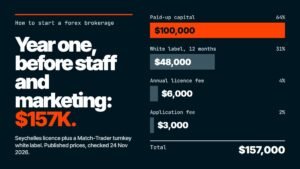
Forex marketing is how a forex or CFD broker finds traders, gets them to fund an account and keeps them trading, and the licence decides your channel mix before your budget does. A broker with a UK or Australian licence can run certified Google ads in that country. An offshore broker can’t. To reach UK residents it needs FCA authorisation or an authorised firm to approve each promotion, and marketing to EU residents without an EU licence means providing services there without authorisation. If you’re still choosing a licence, the guide on how to start a forex brokerage compares what each one costs.
This guide is for broker founders and marketing heads. We checked every ad policy and affiliate rate in it on the platform’s or broker’s own page on 25 November 2026. Where a number isn’t published, it says so.
Which marketing channels can a forex broker use?
A forex broker can use paid search, paid social, affiliates and introducing brokers (IBs), SEO and content, review and listing sites, email, PR and events. Which of those are open depends on the licence. Paid ads need a licence each platform accepts for the target country plus platform certification, and Meta doesn’t allow CFD ads at all.
| Channel | Open to an offshore broker? | What it needs | How you pay |
|---|---|---|---|
| Google Ads | Only in listed countries, with a licence from that country’s listed regulator | A licence from the listed regulator (an EEA licence covers the listed EU countries) plus Google certification | Per click |
| Meta (Facebook, Instagram) | No for CFDs, in any country | CFD trading is on Meta’s prohibited list | Per impression or click |
| TikTok | Banned for forex in the UK, most of the EU and Latin America | Local licence where allowed | Per impression or click |
| X | Yes, in countries on X’s list, with the local licence | Local licence and X certification | Per impression or click |
| Microsoft Ads | Only after financial services verification | Verification, plus local licence in markets like the UK, Cyprus and Australia | Per click |
| Affiliates (CPA) | Yes, but you’re responsible for what they publish | Tracking, fraud checks, promotion rules in each client’s country | One-off payment per qualified client |
| Introducing brokers | Yes | IB agreement, KYC on the IB | Share of spread or a rebate per lot |
| SEO and content | Yes | Time and links | Writers, links, tools |
| Review and listing sites | Yes | Check the site’s own ad rules | Flat listing fee or CPA |
| Email and retention | Yes | Consent under GDPR or local rules | Software and staff |
Nobody publishes what a funded trader costs by channel. We looked through broker filings, trade press, Reddit and trader forums on 25 November 2026 and found total acquisition costs and vendor “benchmarks” that contradict each other, but no channel-by-channel numbers from a broker.
What broker executives do say in public is that the cheapest channel on paper often isn’t. In October 2026, BlackBull Markets’ business development chief Anish Lal gave the example of an $800 CPA paid against an average first deposit of $400 to $500, which the broker expects to recover only if the client deposits again and keeps trading over the next six to twelve months. A Latin America consultant, Sebastián Rivas, estimates that mature brokers get 40% to 70% of new funded clients through partners such as IBs, trading academies, educators, affiliates and trading communities. He sells market-entry services to brokers and names no source for that figure, so treat it as an opinion.
Industry expos such as iFX EXPO are a business-to-business channel. The sources we found, including Finance Magnates, which belongs to the same group as iFX EXPO, mostly describe them as places to meet IBs, affiliates, payment providers and tech vendors. We found no broker saying it got retail traders from one, and no published exhibitor return figures.
Can forex brokers advertise on Google and Facebook?
Forex brokers can advertise on Google only in countries Google lists, only with a licence from that country’s regulator and only after Google certifies the account. Meta doesn’t allow CFD trading ads anywhere. Both rules were checked on the platforms’ own policy pages on 25 November 2026.
Google Ads
Google treats CFDs, spread betting and rolling spot forex as “complex speculative financial products”. An advertiser has to be a licensed provider or aggregator, follow local law, target an eligible country and hold Google certification. From June 2026 the certification application moved inside the Google Ads account. The eligible list includes the UK (FCA), Australia (ASIC), the US (NFA, rolling spot forex only), Singapore (MAS), South Africa (FSCA), the UAE (CMA, DFSA or FSRA) and most EU and EEA states. France, Spain and Belgium don’t appear on the page at all, so you can’t target them. Google also lists affiliate sites with broker reviews as a reason to disapprove ads.
Meta (Facebook and Instagram)
Meta’s prohibited financial products page lists “Contract for difference trading” among the things ads can’t promote, next to binary options. There’s no licence exception on that page. Spot forex isn’t named, and Meta doesn’t say how it treats rolling spot forex. Most retail forex at brokers is sold as CFDs, so expect most broker ads to be rejected, but that is our reading, not Meta’s wording.
TikTok
TikTok’s financial services policy, updated September 2026, names “forex trading” as not allowed in the UK, Israel and most EU countries, and bans CFDs and FX services across Latin America. It may allow licensed forex trading ads in Croatia, Estonia, Latvia, Lithuania, Serbia, Slovakia and Slovenia. France, Germany and Finland list “Foreign Exchange (FX) services” as possibly allowed, and TikTok doesn’t say whether that means currency exchange or leveraged trading.
X
X allows CFDs and currency trading in the countries it lists, with the local licence. In the UK that means an FCA or Gibraltar licence. Spread betting and binary options are banned.
LinkedIn doesn’t name forex or CFDs. Financial ads in the UK can only come from FCA-authorised firms, and the advertiser needs pre-approval with its FCA reference number.
Microsoft Advertising
Microsoft updated its financial services policy on 20 November 2026. Every financial advertiser, affiliates and lead generators included, has to pass verification first. The UK needs FCA authorisation, Cyprus needs CySEC or an EEA passport, and Australia needs an AFSL. A November 2026 update added a prop trading section. It bans ads from prop firms that offer customers leveraged or derivatives trading or live execution, lets other prop firms advertise only through an approved program in 14 markets, and bans affiliate, broker-review, signal and tip sites that promote prop trading.
| Platform | CFD ads | What you need |
|---|---|---|
| Allowed in listed countries | Local licence plus Google certification | |
| Meta | Not allowed | CFD trading is prohibited |
| TikTok | Banned in UK, most of EU, Latin America | Local licence in the few markets that allow it |
| X | Allowed in listed countries | Local licence and certification |
| Not named | FCA authorisation and pre-approval in the UK | |
| Microsoft | Not named, verification required | Verification plus local licence by market |
How do forex affiliate and IB programs pay?
Forex affiliate programs pay in three ways: a one-off CPA per qualified client, a share of the revenue the client generates, or a fixed rebate per lot traded. On published pages checked on 25 November 2026, CPA ceilings run from $600 to $2,000, revenue share ceilings from 40% to 85%, and per-lot rebates from $2.50 to $30. Brokers don’t share on the same base: some pay on spread only, others on spread and commission or on net revenue.
| Broker | CPA (published) | Revenue share | Per-lot |
|---|---|---|---|
| AvaTrade | Up to $2,000 | Up to 50% of spread, lifetime | Fixed, amount not published |
| Exness | Up to $800 to $1,750 by region | 20% to 40% of spread | Not published |
| Vantage | Up to $1,200 (tier 1 countries) | Up to 40% on forex, up to 70% on crypto CFDs (Perpetual account only) | Up to $8 |
| Pepperstone | $300 to $800 by client country | Up to 50% (IB) | Not published |
| Axi | Up to $600 | Up to 55% (IB) | $4 in its calculator |
| HFM | Not published | 60% | Up to $30 |
| Tickmill | Not published | Up to 55% (Classic account) | $2.50 round turn (Raw account) |
| RoboForex | Not published | Up to 85% of spread plus 30% of swap | $10 per EUR/USD lot in its example |
Every CPA figure above is a ceiling, and most depend on the client’s country, deposit size or trading volume. What a client has to do before the affiliate gets paid is where the programs differ, and only a few brokers publish it:
- XM: $150 in deposits and 3 standard lots within 12 months, trades shorter than 3 minutes don’t count, and no commission for clients in Belgium, Poland, Spain or Portugal (from its Cyprus entity’s agreement, July 2026).
- AvaTrade: the client has to trade until spread reaches $50. CPA is clawed back on chargebacks and fraud, and client bonuses are deducted from revenue share.
- Axi: the client has to reach “400k standard volume”, a unit the page doesn’t define.
- Exness: the first deposit counts everything deposited in the first 24 hours, and the client needs “sufficient trading activity”, with no number given.
- FBS: no commission on the IB’s own or relatives’ accounts, and half commission on bonus accounts.
Two things stood out. AvaTrade is the only broker we checked that publishes its cookie length (lifetime). And none of the brokers we checked publishes how many referred clients actually qualify. If you’re designing your own program, set the qualifying rule first, because the “up to” number is what affiliates compare and the rule is what decides your real cost.
FBS publishes three different IB rates on its own pages (up to 43% in the menu, a fixed 30% in its help centre, flat per-lot amounts in its partner agreement), so we haven’t used any of them as its rate. These are mostly the brokers’ international terms. The XM rules above come from its Cyprus entity’s agreement, and other entities may differ. Pepperstone says some of its partner programs aren’t available in the EEA, the UK or Australia.
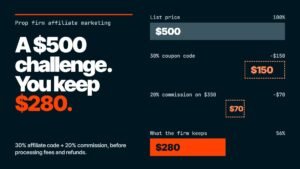
The abuse side is the same as in prop trading: self-referrals, bonus hunters, stolen-card deposits and affiliates who buy traffic you’d never approve. I wrote about those patterns in prop firm affiliate marketing, and most of it carries over to brokers.
Does SEO work for forex brokers?
SEO works for forex brokers, but slowly, and the queries a new broker can win are narrow. “Forex broker” averaged about 110,000 searches a month worldwide over the past year, though a spike in mid-2026 inflates that average and October 2026 saw about 33,000. The top results are mostly review and comparison sites. A new broker’s realistic targets are qualification queries: the broker’s own name plus “review”, “regulated”, “minimum deposit”, “MT5” and “withdrawal”.
The demand data supports that. In my forex keyword research, the broker-side searches with real volume are traders checking whether a broker is safe and what it costs, not traders browsing for a new one.
SEO doesn’t depend on an ad platform approving your account, which is why agencies call it the highest-return channel for brokers, but we found no broker data comparing its cost per funded trader with IBs or paid ads. If you want someone to run it, see forex broker SEO.
Are forex broker review sites worth paying for?
A paid listing on a review site is worth it if you’re buying placement and traffic you can track. It isn’t if the deal includes a better score or fewer complaints, and traders know some sites sell exactly that.
In 2024 DL News reported on a WikiFX sales pitch that priced positive reviews in Thailand, Indonesia, Malaysia and Vietnam at about $128,000 a year. WikiFX didn’t respond to DL News and has called similar claims false elsewhere. Trustpilot removed more than 3.3 million fake reviews in 2023, and Finance Magnates found a seller offering 1,000 five-star reviews for $3,997. On the other side, ForexBrokers.com says partners can pay for referrals but can’t pay to change a review or score.
Before you pay a review site, check four things:
- How you pay. CPA per qualified client keeps the risk on the site. A flat fee puts it on you.
- Tracking. You need your own tracking link and the right to see which clients it sent.
- Disclosure. The site should say on the page how it makes money.
- What’s for sale. If the offer mentions ratings, rankings or removing complaints, walk away.
Also remember that Google lists affiliate sites with broker reviews as a reason to disapprove ads, so a review site’s traffic mostly comes from organic search, not paid ads. We found no published data on whether a paid listing turns into funded traders.
Disclosure: I work with FinMedia Group, which runs MyTradingReviews.com, a broker review site.
What are the rules for forex advertising by region?
In the UK, only an FCA-authorised firm, or a firm whose promotion an authorised firm has approved, can advertise CFDs and forex to retail clients. In the EU, a broker needs an EU licence or passport to market to clients there. Every CFD promotion in both needs a set risk warning, and an offshore licence doesn’t change that if you target residents there. Australia adds its own CFD restrictions.
UK. Under section 21 of the Financial Services and Markets Act 2000, nobody can promote an investment in the course of business unless they’re FCA-authorised or the promotion is approved by an authorised firm. The rule covers promotions from outside the UK if they can have an effect there. Breaking it is a criminal offence under section 25, with up to two years in prison. Since 7 February 2024, an authorised firm also needs the FCA’s “approver permission” to sign off promotions for an unauthorised one, unless an exemption applies, such as approving for its own group. The FCA’s 2024 guidance on social media (FG24/1) says affiliates and influencers who promote without approval may be committing a criminal offence.
CFD risk warnings. In the UK, CFD, spread bet and rolling spot forex promotions on websites and in durable media carry a three-sentence warning with the firm’s own percentage of losing retail accounts, recalculated every three months over the past 12 months. The nine broker companies Forex Broker Review tracks showed figures between 64.65% and 77.97% in November 2026. A firm with no retail trades in that period uses a set “vast majority” wording instead. Other media use a shorter version, and ads on platforms with character limits can use “[x]% of retail CFD accounts lose money” with a direct link to the full warning. On websites and apps the warning sits in its own border, fixed at the top of the screen. EU national regulators, including CySEC, based their warnings on ESMA’s 2018 measure. CySEC kept the percentage warning but changed the standard wording.
EU and offshore brokers. ESMA’s statement of 13 January 2021 says that any marketing to EU clients, through any channel or person, means the client didn’t come to the broker on their own initiative, whatever the terms and conditions say. That ends the “reverse solicitation” argument for an offshore broker that advertises into the EU.
Australia. ASIC’s CFD order, in force since March 2021, caps leverage, requires negative balance protection and bans certain inducements. It runs to 23 May 2027 and ASIC has proposed extending it to April 2031.
How should brokers handle email and retention?
Retention decides whether acquisition spend pays back, so the first job of email and account managers is to turn a sign-up into a funded, trading client. A registration is not a funded account, as NAGA’s senior regional director Alexandru Badea put it in October 2026.
We found only two listed brokers that publish numbers showing this. NAGA said 7.8% of its sign-ups funded an account in Q3 2026, up from 7.3%. Plus500 said about half of its 2025 OTC revenue came from customers who had traded with it for more than five years, up from 24% three years earlier. We found no broker that publishes churn or lifetime value.
The trader’s side shows what goes wrong. The complaint we found most often on r/Forex was repeated sales calls after a demo sign-up. In two 2021 threads, traders described one or two calls a day, from new numbers each time they blocked one. On BabyPips one trader with a CySEC-licensed broker said an account manager asked for more money every other day and talked them out of a withdrawal. Other users called discouraging withdrawals a red flag and told them to complain to the regulator. In other threads, some traders said an account manager was a useful contact, while others said the calls were mostly about how much they would deposit.
That points to a simple order for activation emails and calls: finish verification, make the first deposit easy, help with the platform and the first trade, then leave the client alone unless they ask. Measure every source by what its clients deposit and trade after 30, 90 and 180 days, not by sign-ups. Badea’s point was that before replacing a marketing team, a broker should join its marketing, CRM and deposit data and compare clients by source. Email also needs consent under GDPR in the EU and UK.
What are the most common forex marketing mistakes?
The mistakes that come up most in broker interviews and regulator notices are paying for cheap first deposits that don’t stay, counting sign-ups as results, failing to supervise affiliates, and using bonuses or offshore entities to get around retail rules.
- Buying volume on CPA. BlackBull’s Anish Lal compared two introducers paid the same CPA: one sends $1,000 depositors who stay eight to ten months, the other $300 depositors who mostly leave within 60 days. On a pure CPA deal, the broker pays both the same.
- Counting registrations. NAGA’s Alexandru Badea says brokers facing falling deposits replaced marketing teams or agencies before checking their own data by source.
- Not policing affiliates. CySEC told brokers in 2017 to supervise affiliates’ marketing, check who runs their sites and drop partners who break the rules. The FCA’s 2024 social media guidance (FG24/1) explains when affiliates and influencers fall inside the UK promotion rules.
- Leading with bonuses. EU and UK rules have barred monetary and non-monetary incentives for retail CFD clients since 2018, including account-opening bonuses and volume rebates.
- Pushing UK clients offshore. In October 2025 the FCA said firms must not push UK retail clients toward associated offshore CFD providers or toward elective professional status, and warned that finfluencers were promoting unregulated offshore firms.
There’s also a cost in people. A study of 40 marketing chiefs at 38 CFD and online trading firms from 2014 to 2024 found a median tenure of 17.5 months, with nearly 40% gone within a year. The agency behind it put that down to founders expecting fast growth.
How much does forex marketing cost?
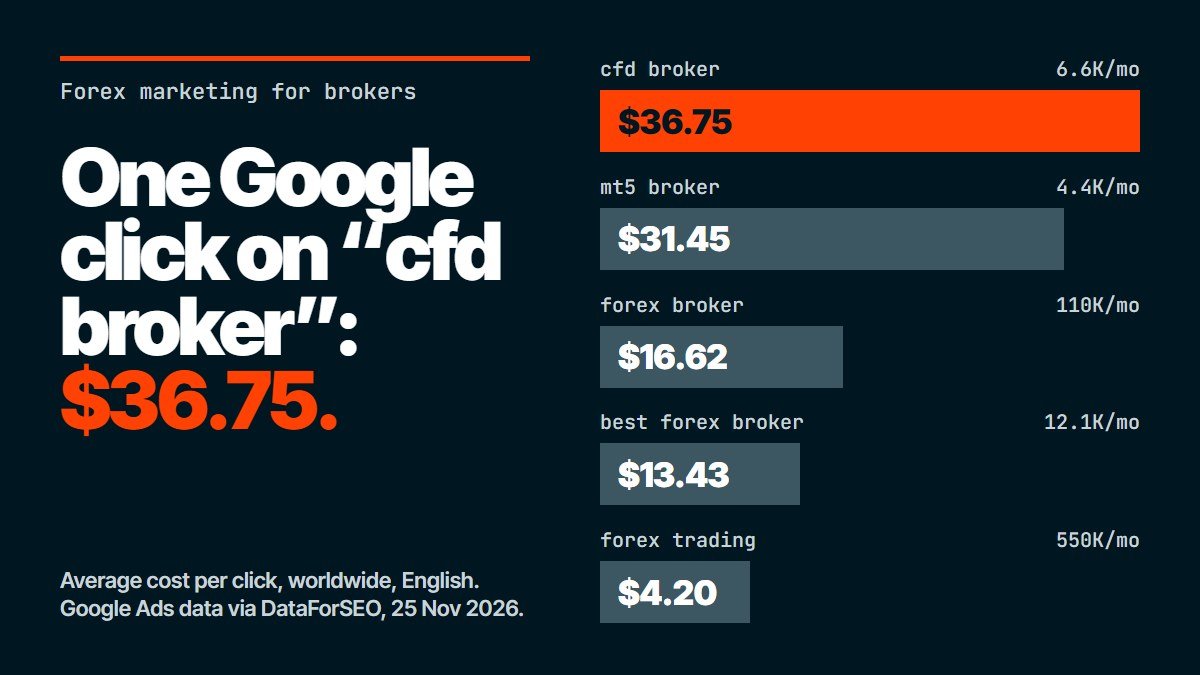
Paid search for broker terms is expensive. On Google Ads data pulled on 25 November 2026, “forex broker” averages $16.62 a click worldwide, “mt5 broker” $31.45 and “cfd broker” $36.75. Affiliate CPA on published broker programs runs from $600 to $2,000 per qualified client.
| Keyword | Avg monthly searches (12 months) | Average CPC |
|---|---|---|
| cfd broker | 6,600 | $36.75 |
| mt5 broker | 4,400 | $31.45 |
| forex broker | 110,000 | $16.62 |
| best forex broker | 12,100 | $13.43 |
| open forex account | 880 | $9.69 |
| forex trading account | 2,400 | $6.77 |
| forex trading | 550,000 | $4.20 |
| forex trading app | 60,500 | $2.83 |
Those are worldwide averages across English searches. The CPC in a country where you can actually run CFD ads, like the UK or Australia, will differ.
Few brokers publish what a client costs them. According to Finance Magnates Intelligence, NAGA’s marketing spend equalled 40.5% of revenue in the first half of 2026, down from 46.5% a year earlier. Plus500 said its average acquisition cost fell by more than 10% in 2025 but didn’t give the figure. Per-FTD “benchmarks” from tracking vendors and agencies contradict each other, sometimes on the same vendor’s blog, so we haven’t used them.
To work out what a funded trader really costs you across channels, use the same method as in my prop firm CAC guide: total spend per channel divided by traders who deposited and traded, not by sign-ups.
If you’d rather hand this to someone, I offer marketing for forex brokers as a consultant.
FAQs about forex marketing
Can forex brokers run Facebook ads?
Not for CFDs. Meta doesn’t allow ads for contract for difference trading, with no licence exception, and doesn’t say how it treats spot forex. See Meta (Facebook and Instagram) above for the full rule.
Is buying forex leads worth it?
No. Bought forex lead lists are tied to scam call centres in leaked records and regulator warnings, and a 2018 FinanceFeeds report found the same leads were often sold to many brokers. In 2025, leaked records from the OCCRP-led Scam Empire investigation showed one call-centre network paid affiliates at least $11 million in 12 months for bringing in depositors. Buying personal data for marketing without valid consent can also break GDPR and UK marketing rules.
CPA or revenue share: which should a broker offer?
Revenue share ties the affiliate’s pay to how long the client trades, so it suits a broker worried about low-quality traffic. CPA pays once and up front, which attracts affiliates but leaves the broker carrying the loss if the client leaves early. AvaTrade, Axi and Pepperstone all offer a hybrid of the two. Axi publishes its hybrid terms: up to $300 per qualified client plus up to 40% revenue share.
What do forex brokers spend on marketing?
Few brokers publish it. According to Finance Magnates Intelligence, NAGA, a listed broker, spent the equivalent of 40.5% of revenue on marketing in the first half of 2026, down from 46.5% a year earlier. Plus500 reported that its average acquisition cost fell by more than 10% in 2025 without giving the figure.
Do offshore brokers need a licence to advertise in the UK?
Not strictly, but an unauthorised broker can’t promote to UK residents on its own. Section 21 of the Financial Services and Markets Act covers promotions from outside the UK that can have an effect there. The broker must be FCA-authorised or get each promotion approved by an authorised firm, and since 7 February 2024 that firm needs FCA approver permission unless an exemption applies, such as being in the same group. Breaking the rule is a criminal offence.
Sources, all checked 25 November 2026: Google Ads financial services policy, Google complex speculative financial products policy, Meta prohibited financial products policy, TikTok financial services ad policy, X financial services ad policy, LinkedIn financial services ad policy, Microsoft Advertising financial services policy, FSMA 2000 section 21, FSMA 2000 section 25, FCA COBS 22.5, FCA PS23/13, FCA FG24/1, ESMA product intervention notice (2018), ESMA reverse solicitation statement (2021), ASIC 26-239MR, Qurium and OCCRP, Scam Empire affiliates, Finance Magnates on NAGA, FinanceFeeds on lead recycling (2018), FBS help centre, AvaTrade partners, Exness affiliates, Vantage partners, Pepperstone partners, Axi partners, HFM partners, Tickmill partners, RoboForex partners, XM affiliation agreement, FBS partners agreement.