Everyone in this industry is now selling AI citation share as the thing to buy. The data says citations are real and worth far less than the pitch implies. Across the sites I run, the most extractable pages hold the best positions and earn the fewest clicks, and one page ranking three positions lower than another earns a hundred times the click rate.
A vendor emailed me last month offering to get my clients “cited in AI Overviews.” No mention of traffic, leads, or revenue. Citation was the deliverable and citation was the win.
That pitch is going to land a lot in 2026, especially with prop firms, because prop firms already know traders ask AI whether a firm is legitimate before they buy a challenge. The fear is real. The product being sold against it is priced on a metric nobody has connected to money.
I spent close to a decade as a web search quality evaluator for Google before moving into SEO, and I now run content across several prop trading and forex media properties. That combination is why this piece leans on Search Console data rather than on what the citation studies say in isolation.
Here is what the numbers actually show, including my own.
YouTube wins the citation in finance, and it is not close
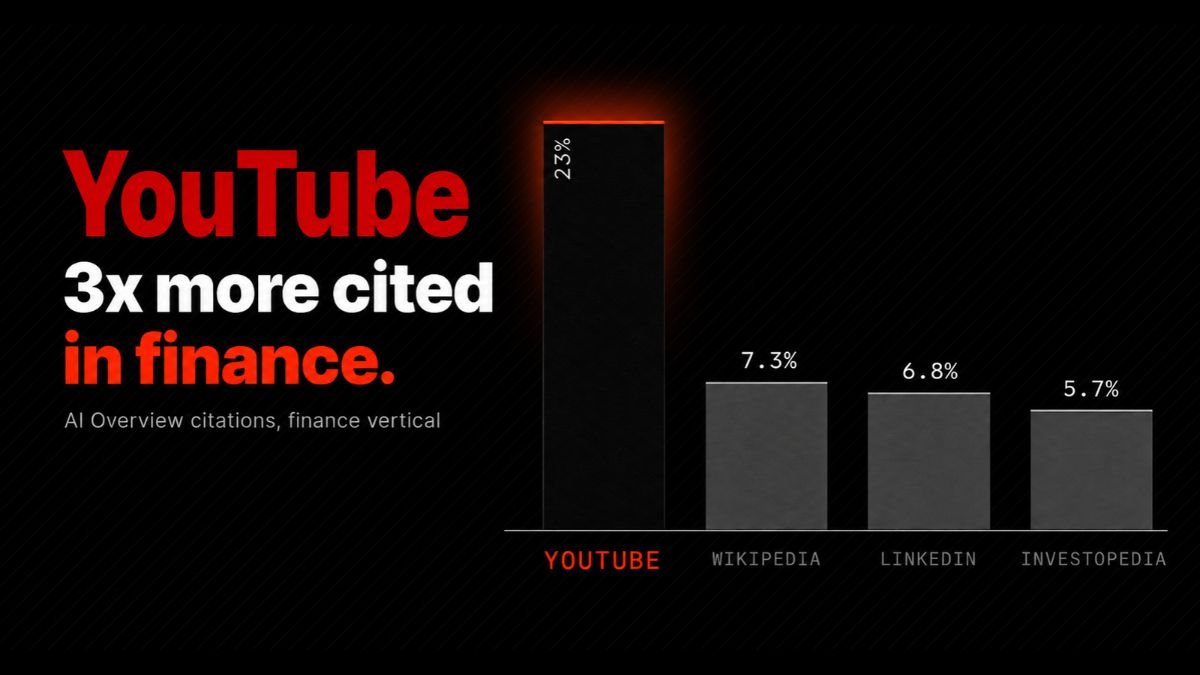
Surfer built its AI Citation Report on 36 million AI Overviews and 46 million citations collected between March and August 2025. In the finance vertical, YouTube leads at around 23%. Wikipedia sits second at 7.3%. LinkedIn takes 6.8%. Investopedia takes 5.7%.
YouTube is not narrowly ahead. It is more than three times the next source.
Across all verticals the pattern holds. YouTube accounts for 23.3% of every AI Overview citation Surfer measured, ahead of Wikipedia at 18.4% and Google’s own properties at 16.4%. Surfer’s own conclusion was that video is the single most cited content format in every category they looked at.
If your win condition is citation share, that finding tells you exactly what to buy. Make video.
And that is where most of the analysis stops.
What is the click through rate on an AI Overview citation
Pew Research tracked the actual browsing behaviour of 900 US adults through March 2025, covering 68,879 Google searches, of which 12,593 produced an AI summary. Not a survey. Real logged behaviour.
Two findings from Pew’s analysis of AI summaries and click behaviour matter here.
When an AI summary appeared, users clicked a traditional search result in 8% of visits. When no summary appeared, they clicked in 15% of visits. The presence of the summary cut clicking roughly in half.
The second finding is the one that should reprice the whole product. Users clicked a link inside the AI summary in about 1% of visits. Being one of the cited sources produced a visit one time in a hundred.
Read that as a purchase decision: a vendor selling you citation placement is selling a mention that converts to a visit around 1% of the time, in an environment where the summary above it also suppressed your organic click by half.
Pew also found users ended their browsing session 26% of the time after a page with an AI summary, against 16% without. The summary is not a doorway. It is frequently the destination.
What that looks like across a network of sites
I run SEO across several prop trading and forex media properties, so I can check this against data I own rather than argue it from other people’s studies.
I pulled the last three months of Search Console across those properties, took the pages with enough impressions to mean something, and sorted them by one question: does this query already have a consensus answer that Google can state without me?
Then I compared click-through at similar positions.
| Page type | Consensus answer exists | Avg position | CTR |
|---|---|---|---|
| Emerging category nobody had covered | No | 7.7 | 2.3% |
| Teardown of a contested detection method | No | 8.1 | 1.0% |
| Explainer on a disputed rule type | No | 9.9 | 0.7% |
| Regional “best firms” list | Yes | 9.0 | 0.4% |
| Single brand review page | Yes | 8.4 | 0.2% |
| Single-fact record lookup | Yes | 8.5 | 0.1% |
Group those by category and hold position constant. Among pages ranking in the top ten, the ones answering questions with no consensus answer earn around four times the click-through of the ones answering settled facts, at an almost identical average position. Same domains. Same authority. Same page of results.
The sharpest single case runs the other way to everything SEO reporting trains you to expect. One page covering a niche mechanism comparison sits at position 11.9 and earns 6.8%. A single-fact page ranking three and a half positions higher earns under a tenth of a percent. The lower-ranked page earns roughly a hundred times the click rate of the higher-ranked one.
The worst offenders are the pages with the biggest impression counts. A record-lookup page pulling five figures of impressions per quarter converts about one visitor per thousand. Google reads it, uses it, answers with it, and sends nothing back.
My own page on how prop firms get cited in AI Overviews makes the point better than any table. It holds an average position under 7. Over the last quarter it earned zero clicks. A page about winning citations, ranking on the first page, sending nobody anywhere.
On the limits of this: the sample is roughly 115,000 impressions across a dozen pages I classified myself, and the classification is a judgement call rather than a controlled variable. Treat it as directional evidence from one operator’s data, not a study.
Position is not the variable. Authority is not the variable.
The variable is whether a consensus answer already exists. Where one does, Google states it and the impression is spent. Where none exists, the reader has to click to find out.
The uncomfortable version
Being highly citable and being worth clicking are close to opposites. A page becomes citable by containing a clean, extractable, consensus answer. That is precisely the page a reader never needs to open.
Optimising hard for citation is optimising your content into a format Google can consume without paying you.
Why citation still has value, just not the value being sold
None of this means AI visibility is worthless. It means it is a branding buy dressed up as a performance buy.
There is one situation where the citation genuinely closes the loop, and prop firms sit right inside it.
A trader types “is [firm] legit” into an assistant. The answer comes back naming your firm, describing your payout record accurately, and not repeating a two-year-old Reddit complaint. That answer did its job whether or not the trader clicked anything. The purchase decision moved. No visit required, and no visit will ever appear in your analytics.
Compare that to a trader searching “what is a prop firm.” The AI answers it, nobody clicks, and nothing about your business changed. You were cited. So what.
The test is simple. Does the mention itself do the work, or does the mention only matter if it produces a visit? If it is the second one, the Pew number applies and you are buying a 1% conversion.
Citation is worth buying
Brand-name queries, legitimacy checks, payout reputation, comparison prompts where being named is the outcome. The answer persuades on your behalf.
Citation is not worth buying
Definitions, explainers, generic category questions, anything where you need the reader on your site to make money. The click never comes.
This is the same distinction I have written about in prop firm reviews, SEO, and trust. Third-party sources own your brand-name search results whether you like it or not, and what those sources say about you is what the model repeats.
Where video actually fits
Given the Surfer data, video is the strongest format available for the citations that are worth having. It also comes with limits that get left out of the pitch.
The advantage is specific to Google. Citation studies published through 2026 put Reddit ahead of YouTube for social citations inside ChatGPT and Perplexity, though those figures come from vendor research rather than an independent dataset, so treat the direction as solid and the exact split as soft. Sell it as a “get cited in AI” product and you are overselling. Sell it as a Google AI Overviews and AI Mode product and it is accurate.
Gemini, Copilot and the AI Overview system alike do not watch anything. They read the transcript, the captions, the chapter markers, the title, and the description. A video where a presenter says “great conditions, fast payouts” produces a transcript with nothing to extract. A video that states the profit split as a percentage, names the drawdown type using that word, gives the fee per account size, and puts the payout cycle in days produces a transcript that reads like a specification sheet. Only one of those gets used.
Disclosure: I am Head of Media at FinMedia Group, which owns FundedTrading.com and MyTradingReviews.com. Both run YouTube channels that publish prop firm reviews, and both sell paid video placements. Read the section above with that in mind, and note that the argument I have just made lowers what a citation is worth, including the ones we sell.
Are AI Overview citations worth buying for a prop firm
Four questions, in order. If any one of them fails, stop.
- Does the mention itself change the buying decision, or do you need the visit? If you need the visit, the Pew number is your ceiling.
- Are your buyers in Google’s ecosystem or ChatGPT’s? Video is a Google play. Text and your own documentation carry more weight elsewhere.
- Is the query you want to own already answered by consensus? If so, you will get cited and earn nothing, and no amount of spend changes that.
- Is there a specific, checkable fact about your firm that the models are currently getting wrong? That is the case where this is worth real money.
The fourth question is the only one I have seen produce a clear return. A firm changed its payout schedule, every assistant kept quoting the old one, and traders were making decisions on stale information. Fixing what the sources said fixed the answers. Nobody had to click anything.
That is a reputation repair job, not a traffic channel, and it should be priced and measured like one. If you are tracking it in a traffic report you will conclude it failed.
For anything where you actually need visits, the old work still applies. Own the queries with no consensus answer, cover the parts of your rulebook nobody else has documented, and build the pages that match real trader intent rather than keyword variations. The pages that work on my own properties are the ones covering things like hedging rules across firms and how firms detect coordinated trading abuse, where practitioners still disagree and Google has no settled answer to state. That is unglamorous and it still outperforms citation share by a distance on my own data.
Thinking about a YouTube video review of your firm
Apply the test above first. If the queries you care about are brand-name and legitimacy checks, where being named accurately is the whole outcome, video is the strongest format available and I can produce one. That means a scripted review of your firm on the channels I run, with your rules, fees, platforms and payout terms stated out loud, chaptered, and captioned properly, so an answer engine can actually quote it.
If what you need is traffic to your site, or your buyers research inside ChatGPT rather than Google, I will tell you on the first call that this is the wrong spend. Get in touch and say video review.
Get in touchFAQs on whether AI citations are worth buying
Are AI Overview citations worth it for a prop firm?
It depends on whether the mention alone moves the buying decision. On brand-name and legitimacy queries it does, because a trader reading an accurate answer about your payout record has been persuaded without visiting anything. On informational queries you need the click, and the click almost never comes.
If citations do not pay, why does anyone buy them?
Because for brand-name and legitimacy queries the mention is the conversion. A trader who reads an accurate answer about your payout record has been persuaded without visiting anything. The mistake is applying that logic to informational queries where you need the visit.
Does a better ranking position still mean more traffic?
Not reliably. In three months of Search Console data across the properties I run, a page at position 11.9 earned roughly a hundred times the click-through of a page at position 8.5. What separated them was whether Google could answer the query without sending anyone anywhere.
Should I stop optimising for AI answers?
No, but stop reporting it as a traffic channel. Measure it the way you would measure a mention in a trade publication, and keep a separate budget for the pages that have to earn clicks.
Does this apply outside prop trading?
The Pew data is general and the mechanism is general. The finance citation split is specific to finance, so the format recommendation may differ in another vertical even though the citation-versus-click problem does not.