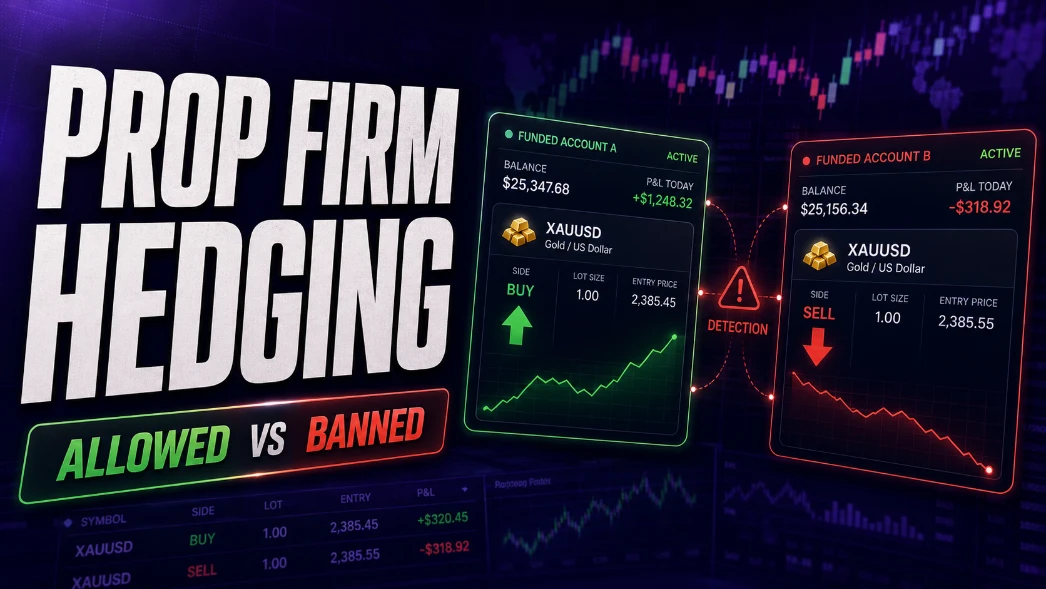
Prop firm hedging means using offsetting positions to reduce or cancel out trading exposure. In funded trading, the real question is not whether hedging exists. It is whether the hedge sits inside one account, across multiple prop accounts, across firms, or through a personal broker.
Most traders use one word for four different things. Same-account hedging may be allowed. Cross-account hedging is usually banned. Cross-firm hedging is easier to detect than most traders think. And automated hedge systems can look smart until a payout review turns the whole thing into an expensive lesson.
What is prop firm hedging?
Prop firm hedging is any setup where a trader opens an offsetting position to reduce, lock, or transfer risk on a funded account. The rule problem starts when the hedge removes real evaluation risk instead of managing a real trading position.
In normal trading, hedging can be fine. A trader might reduce exposure on EUR/USD, protect a gold position, or offset index risk before big news. The hedge still belongs to the same account and the trader still carries real execution risk.
In prop trading, the same word often describes a banned shortcut. A trader buys one account, sells another account, lets one pass, and drops the loser. That is not risk management. It is payout arbitrage.
If you are new to how prop firms work, this difference matters. The funded trading model is built around testing risk control. Hedging across accounts makes that test worthless.
Is hedging allowed on prop firm accounts?
Hedging is sometimes allowed inside one trading account, but hedging across accounts is usually banned. Always check the firm’s rules because the same word can mean four different things: same-account hedging, cross-account hedging, copy-trading hedges, or cross-firm hedging.
| Hedging type | What it means | Typical prop firm position | Main risk |
|---|---|---|---|
| Same-account hedging | Buy and sell the same instrument inside one account | Often allowed on MT4 or MT5 forex accounts | Platform and firm-specific rules |
| Cross-account hedging | Long on Account A, short on Account B | Usually banned | Account closure and payout denial |
| Cross-firm hedging | Long at Firm A, short at Firm B | Banned or treated as abuse by many firms | Cross-firm detection and blacklist risk |
| Correlated-market hedging | Opposite exposure on related instruments such as ES and NQ | Risky and often restricted | Detection as hidden exposure |
| Personal broker hedge | Prop account trade offset through a live broker | Depends on terms and detectability | Execution mismatch and payout review |
BrightFunded’s help center is a good example. It says same-account hedging is allowed, but hedging the same instrument across different accounts or different prop firms is not. It also explains what happens when cross-account hedging is detected, including soft and hard breach outcomes (BrightFunded Help Center, March 2026).
FTMO does not use the word hedging in the same way, but it says total allocation is capped at $400,000 per trader or strategy. Trading the same strategy across multiple accounts can lead to suspension when that limit is crossed (FTMO FAQ).
The simple version: “Multiple accounts allowed” does not mean “opposite trades allowed.” These are two completely different things.
How does cross-account prop firm hedging work?
Cross-account hedging works by placing opposite trades on two funded accounts so one account wins when the other loses. The trader tries to keep the winning account, drop the losing one, and use the challenge fees as a fixed cost.
The basic version looks like this:
- The trader buys two challenges or funded accounts.
- Account A goes long EUR/USD, gold, NQ, or BTC.
- Account B goes short the same instrument or a close substitute.
- A strong move pushes one account toward the profit target.
- The other account hits drawdown or gets abandoned.
- The trader tries to withdraw from the winner.
This is why firms ban it. The trader is not showing skill, risk control, or a real strategy. They are gaming the evaluation format.
This also connects to the wider problem with the prop firm challenge model. If a trader can buy multiple accounts, go both ways, and only keep the winning one, the results stop proving anything.
Why do traders still try cross-firm hedging?
Traders try cross-firm hedging because they think separate firms cannot see each other’s accounts. The idea sounds simple: one side fails, one side wins, and the payout covers both challenge fees.
That idea has three problems.
First, the math is not as clean as the sales pages say. Spreads, commissions, slippage, platform delays, news fills, minimum trading days, consistency rules, payout caps, and review delays all eat into the supposed edge.
Second, firms do not need to see everything to flag something. A payout review can look at trade timing, instrument choice, position size, device signals, IP patterns, payment data, KYC details, VPS usage, and strategy fingerprints.
Third, the detection tools are getting better. Risk vendors now sell cross-firm hedger detection, strategy fingerprinting, device and IP matching, copy-cluster detection, and payout pause tools.
The old belief: “They cannot see my other account.”
The 2026 reality: “They may not need to see everything to decide your payout is not worth approving.”
Can prop firms detect hedging between two different firms?
Prop firms can catch some cross-firm hedging through shared risk vendors, liquidity relationships, trader identity signals, execution fingerprints, and payout reviews. Detection is not perfect, but repeated opposite-position behaviour gets easier to spot over time.
It is usually a cluster of signals, not one big catch. A firm may look at:
- Same or similar KYC identity
- Same payment method or billing pattern
- Same device, browser, VPS, or IP history
- Same instrument traded in opposite directions
- Same entry time or near-identical timestamps
- Same lot size or risk percentage
- Same EA, copier, or trade sequence
- Similar behaviour across trader groups
- Payout timing after aggressive one-sided exposure
Traders often ask: “How would they know?” The better question is: how many signals would they need before they refuse the payout?
Risk vendors now advertise graph-based abuse detection. Forums are full of talk about shared data, strategy fingerprints, and payout reviews. That is the real shift.
Is a brief opposite position a hedging violation?
A brief opposite position can still be treated as a hedging violation if it shows up across multiple accounts, especially on the same instrument or closely related ones. Some firms care about the overlap itself, not the trader’s reason for it.
This is where many traders get angry, and sometimes fairly. A trader may run two strategies: one trend-following and one scalping. For a few seconds, one account is long and another is short. They see it as normal strategy overlap. The firm sees cross-account hedging.
The problem gets worse in futures prop firms because related contracts can be treated as one risk group. ES, MES, NQ, MNQ, YM, MYM, CL, and MCL are not always seen as separate. If one account is long NQ and another is short MNQ, the firm may call that a synthetic hedge.
- Do not place opposite trades on the same instrument across accounts.
- Be careful with closely correlated instruments.
- Avoid identical lot sizes and mirrored timestamps.
- Keep strategy notes if you trade different systems.
- Ask support before using multi-account execution.
That last point sounds boring. Boring is cheaper than losing a payout.
What about hedging a prop account with a personal broker account?
Hedging a prop account with a personal broker account is not the same as cross-account hedging inside one firm, but it can still cause problems with the rules, your execution, and your payout review. The external broker does not make the setup safe.
This is a growing topic because traders think the personal broker side is invisible. The argument is usually: “The prop firm can only see my funded account. My live broker is separate. So I can offset the trade and get my challenge fee back if the prop account fails.”
That sounds tidy until you add different spreads, different fills during fast markets, commission on both sides, slippage during news, minimum trading day rules, consistency rules, withdrawal review, and broker terms on wash-like behaviour.
If you sit on the broker side of this rather than the trader side, the search problem is a different one, and it is the one I cover under forex broker SEO.
Watch out for prop firm hedge EAs that claim they cannot lose. If the sales page promises pass-or-fail profits, challenge fee recovery, and clean payouts without showing the compliance risk, that is a warning sign.
The practical answer: trading your own live account is your choice, but using it to manufacture a prop firm payout can still get your prop account flagged for review.
Why do prop firms ban cross-account and cross-firm hedging?
Prop firms ban cross-account and cross-firm hedging because it bypasses the evaluation model. It turns a skill test into account selection. The trader keeps the winner, discards the loser, and shifts the cost to the firm.
Firms also worry about organised groups. One person may control many accounts. A group may split long and short positions across members. A signal seller may send opposite trades to different accounts. A copy tool may create cross-account exposure without the trader even knowing.
That is why the language has grown beyond just “hedging.” You will now see terms like reverse trading, group hedging, coordinated trading, copy-trading abuse, account farming, strategy mirroring, cross-platform hedging, and inter-account hedging. The names are different. The problem is the same: the trader is reducing or removing market risk in a way the firm did not agree to fund.
What happens if a trader gets caught hedging?
If a trader gets caught hedging across accounts, the usual outcomes are trade closure, account breach, payout denial, account termination, and potential bans. Some firms give a warning for a first small offence, but others close accounts right away.
| Consequence | What it means |
|---|---|
| Soft breach | Warning, forced trade closure, account stays open |
| Hard breach | Account closed or failed |
| Payout denial | Profits removed during review |
| Account termination | Funded account access revoked |
| Internal ban | Trader cannot buy again from that firm |
| Wider risk flag | Other firms may treat the trader as higher risk |
This is also where false positives matter. Forums are full of traders complaining about reverse-trading accusations after a single trade, and payout denials without any trade IDs or logs to back them up. A fair review should look at more than one signal: trade timestamps, instrument, size, direction, account ownership, IP or device overlap, copier use, strategy history, and repeated behaviour. One matching trade can look suspicious. A repeated pattern is much stronger evidence.
How can legitimate traders avoid accidental hedging flags?
Traders who are not trying to cheat can still get flagged if they are not careful. Keep your account exposure simple, separate your strategies clearly, write down your logic, and avoid opposite positions across accounts. The more accounts you trade, the more you need to stay organised.
- Read the firm’s exact hedging, copy-trading, and prohibited-strategy rules.
- Ask support whether same-account hedging is allowed on your account type.
- Avoid opposite exposure across accounts on the same instrument.
- Treat correlated futures and indices as connected exposure.
- Do not use one EA to create mirrored trades across accounts.
- Keep a trading journal that explains different strategies.
- Avoid “recovery” bots when an account is already in drawdown.
- Save support replies before risking payout eligibility.
Is prop firm hedging worth it?
Prop firm hedging is not worth it if you want to trade long term. Same-account hedging can be a valid tool, but cross-account or cross-firm hedging puts your payout, your account, and your access at risk.
The short-term appeal is obvious. Buy two accounts. Go both ways. Hope one payout covers the fees. Repeat.
The long-term problem is also obvious. The whole plan only works if firms are slow, disconnected, or not paying attention. That is a weak bet. The industry is moving toward tighter consistency rules, more careful payout reviews, better identity checks, and tools built to catch exactly this behaviour.
The better move is not finding the next trick. It is picking firms whose rules match how you actually trade, and then being boring enough to get paid.
Final takeaway
Prop firm hedging is not one thing. Same-account hedging can be normal risk management. Cross-account and cross-firm hedging are usually treated as abuse because they swap trading skill for account selection. If you are serious about funded trading, drop the shortcut mindset. Firms are getting better at catching this, and the payout review is where most clever plans fall apart.
If you run the firm rather than trade at one, this subject has a search problem attached to it. Traders learn your hedging rules from forums and review sites because your own rules page is not the one that ranks. Fixing that is prop firm SEO. I run FundedTrading.com and FundedTrading.id, and the numbers on both are published.
FAQs about prop firm hedging
Sometimes. Many forex firms allow same-account hedging on MT4 or MT5, but the rule depends on the firm, platform, and account type. Check the written terms before you open any offsetting positions.
Usually no. Cross-account hedging is one of the most commonly banned practices. Even a brief opposite position on the same or a related instrument can trigger a breach or payout review.
Most firms ban it, and the tools to detect it are getting better. Shared risk vendors, identity signals, trade fingerprints, and payout reviews make repeated cross-firm hedging riskier than most traders expect.
Reverse trading usually means opposite positions across accounts, users, or firms. It overlaps with cross-account hedging, coordinated trading, and account abuse depending on how the firm words its rules.
Some may produce short-term payouts, but they often hide grid, martingale, execution, or compliance risk. If the system needs account failure, challenge cycling, or payout review avoidance to work, the risk is bigger than the sales page admits.
A fair review should use more than one signal. Strong evidence includes repeated opposite trades, matching timestamps, matching position size, shared devices, copier behaviour, account ownership links, and strategy-level patterns.