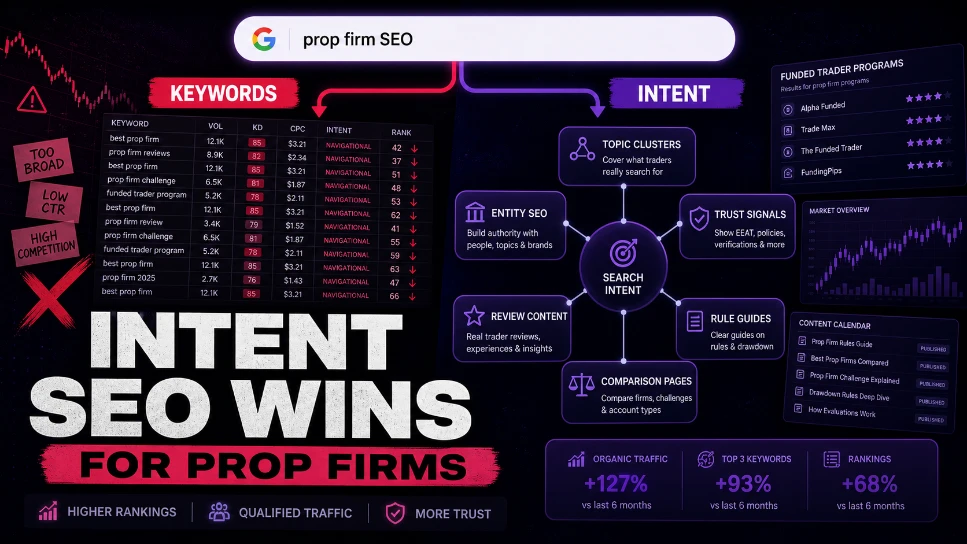
Keyword research is the map. It is not the destination. Prop firm traders search with anxiety baked into every query. Until your content addresses the real question behind the search, the keyword is just a decorative sticker on a page that does not help anyone.
Why do prop firm traders search the way they do?
Prop firm traders search to reduce risk before committing money. The searches are not curiosity-driven. Most of them are triggered by doubt: about a rule, a payout, a firm’s reputation, or a bad experience in a previous challenge. That context shapes the exact phrases they type, and it should shape the pages you build.
The typical prop firm query does not start with “best prop firm.” It starts after something went wrong, or before a trader commits $200 to a challenge they are not sure about.
The internal monologue sounds something like this:
“My consistency rule killed my last challenge. Did I misread it, or is the rule designed to catch people out?”
“My friend got denied a payout after approval. Normal? Or is this firm pulling something?”
“160 prop firms exist and they all look identical. How do I know which one will actually pay me?”
Those thoughts turn into searches like:
prop firm consistency rule explained prop firm payout denied what to do is [firm] legitimate 2026 trailing drawdown vs static drawdown which prop firms actually pay prop firm scam reddit funded account real money or simulated
Notice the doubt modifiers: “legitimate,” “actually,” “denied,” “real,” “scam.” Those words are not decoration. They are the anxiety signal, and they change what the page needs to do. I call this the anxiety modifier pattern: traders tag their searches with the specific concern they cannot resolve from marketing copy alone.
A page optimized for “prop firm” but silent on payout denial, rule mechanics, and trust verification is useless for these searches. The keyword matched. The page did not. That is the failure mode keyword-first SEO produces in this market.
What the prop firm SERP actually looks like in 2026
The prop firm SERP in 2026 is three-layered: AI Overviews for informational and comparison queries, affiliate review sites in the middle, and direct prop firm pages for branded and commercial searches. Pages that explain rules with depth and clarity have the best chance of appearing in AI-generated citations. Coupon pages do not.
Search volume for “prop firm” and related terms grew over 600% in the last four years according to Contentworks. That growth flooded the SERP with thin affiliate content. Most of it says the same thing: high profit split, low price, fast payout. Traders have seen that pitch several hundred times. They stopped reading past the headline.
AI Overviews shifted the distribution further. Google now synthesizes answers for broad queries. For prop firm searches, those overviews pull rule explanations, payout condition breakdowns, and trust frameworks. They are not pulling coupon pages. They are pulling the pages that actually explain how something works.
What I observed in 2026 SERP checks: “Prop firm trailing drawdown explained” triggers an AI Overview citing rule-clarity content. “Prop firm consistency rule” produces a synthesized answer explaining the concept before listing firms. “Best prop firm 2026” still gets a conventional ranked list. The pattern: educational and rule-clarity content gets cited in AI answers. Rankings and discounts get the conventional organic slot.
Perplexity and ChatGPT are now a real part of the prop firm research journey too. Traders use them for initial research before they ever hit Google. That means your content needs to be structured for AI citation, not just for a blue link. Short, direct answers under clear headings. Source-backed claims. Specific attributes rather than generic praise. The same things that help Google understand a page also make it citable in AI tools.
Two audiences hiding inside “best prop firm” searches
The query “best prop firm” contains two distinct audiences. The first is the challenge buyer evaluating firms before spending money. The second is the funded trader who is already past a challenge and checking whether their firm’s rules are standard. These audiences need completely different content, and most prop firm pages serve neither well.
The challenge buyer needs:
Challenge buyer intent
Rule comparisons, payout proof, ownership transparency, Trustpilot patterns, price-to-value analysis, firm sustainability signals.
Funded trader intent
Rule clarification, payout denial context, slippage counting rules, trailing drawdown reset behavior, dispute resolution paths.
A generic “best prop firm” listicle serves neither. It collects a click and loses both visitors within 30 seconds because neither found what they actually came for.
The pass rate context makes this starker. About 7% of traders who enter a prop firm challenge ever receive a funded payout, based on pass rate data tracked across the industry. The remaining 93% are somewhere in the research phase: building a risk model for which firms are worth attempting and which are likely to cause problems later. They are not hunting for a discount. They are doing pre-purchase due diligence on a financial product with a 93% failure rate. The content bar for that audience is considerably higher than a table of coupon codes.
What search intent actually tells you about page architecture
Search intent determines the page structure, not just the topic. In prop firm SEO, intent tells you whether to build a comparison table, a rule explanation, a trust guide, or a step-by-step walkthrough. Getting this wrong is how technically optimized pages fail to rank on queries they should own.
| Query | Real job | Page type needed |
|---|---|---|
| best prop firm | Compare options with rule and risk context | Ranked comparison with scoring criteria |
| prop firm trailing drawdown | Understand how the rule actually works | Concept explanation with trader examples |
| prop firm payout denied | Understand why and what to do next | Cause-and-action guide |
| is [firm name] legit | Evaluate trustworthiness before buying | Structured trust review with methodology |
| prop firm consistency rule | Decode the rule before it kills the challenge | Plain-language rule breakdown |
| funded account real money | Verify what the trader is actually trading | Direct explanation: simulated vs live model |
The mistake most prop firm sites make is building one page for all of these. One “prop firm guide” that tries to explain rules, compare firms, verify trust, and convert readers simultaneously. Semantic soup. Every section fights every other section for topical focus. Google reads it as covering multiple intents and ranks it confidently for none of them.
Each query has one primary job. Build one page per job. Connect them with internal links that follow the logical trader journey. That is how topical authority is built: not by publishing 40 variations of “best prop firm,” but by owning every stage of the decision a trader has to make before clicking the buy button.
How to mine trader language for content your competitors missed
The most useful prop firm content is built from trader frustration, not from a keyword tool. Reddit threads, Trustpilot reviews, Discord servers, and support tickets contain the exact phrases traders use when they search, and the exact questions that thin affiliate pages routinely fail to answer.
The forum mining process is short:
- Find threads in prop firm subreddits, trading Discord servers, and trader forums where people discuss payout denials, rule confusion, or firm comparisons.
- Pull the repeated complaints and questions verbatim. The exact phrases, not summaries.
- Map those phrases to query types: informational, commercial, or trust-verification.
- Build content that answers the question directly in plain language.
- Place it in the part of your cluster that matches the intent stage.
Forum patterns I have seen recently include traders asking why consistency rules exist, whether they are designed to protect the firm rather than reward discipline, and what happens when slippage causes an accidental rule breach. I have seen threads on whether trailing drawdown resets at end of day or tracks peak equity continuously. I have seen funded traders confused about whether their account is simulated or mirrored to live positions, and whether that distinction affects their payout rights.
That language produces real content assets:
Content assets from trader language
“Prop Firm Consistency Rules Explained: What They Actually Measure” — built from traders asking why their profitable account failed the rule.
“Why Prop Firms Deny Payouts: 7 Rules Traders Misread” — built from support ticket patterns and Trustpilot complaint clusters.
“Trailing Drawdown Explained: When It Resets and When It Does Not” — built from the single most repeated technical question in funded trader communities.
“Simulated Funded Accounts: What Traders Are Actually Trading” — built from the discovery moment when traders realize their funded account may not be live.
These articles do not replace commercial pages. They support them. A trader who finds your rule-clarity content before buying a challenge has already established trust in your site before they reach the comparison page. That pre-purchase trust is worth more than any discount code.
For a deeper look at how prop firm reviews and trust signals interact with SEO, including what makes a review page actually credible versus a thin affiliate wrapper, that article covers the full mechanics.
What a clean prop firm content cluster looks like
A functional prop firm cluster is built around one central entity and several decision attributes. The central entity is the funded trading model. The decision attributes are rules, payouts, platforms, reviews, pricing, and trader fit. Every page has one job and links to the next logical destination.
| Cluster layer | Page | Intent | Key sections |
|---|---|---|---|
| Foundation | How prop firms work | Learn the model | Evaluation, simulated accounts, payout structure |
| Consideration | Best futures prop firms | Compare options | Drawdown models, platforms, fees, rules |
| Trust | Prop firm reviews and trust signals | Verify credibility | Payout history, Trustpilot patterns, review methodology |
| Rules | Payout rules and denial causes | Avoid rejection | Eligibility criteria, timing, dispute steps |
| Operator | Prop firm SEO strategy | Grow organic demand | Topic clusters, trust content, AI search |
| Growth | Prop firm marketing | Scale acquisition | Paid ads, affiliates, content systems, retention |
The beginner article links to the model explanation. The comparison page links to the trust guide. The trust guide links to the commercial page. One logical chain. No random internal link confetti.
The other thing that breaks clusters is mixed intent inside a single page. Do not mix “how prop firms work” with “best prop firms in India” with “how to start a prop firm” on the same page unless it is explicitly a hub. Mixed intent produces pages that rank weakly for three things instead of strongly for one.
Why thin affiliate pages survive short-term but fail on trust queries
Thin affiliate pages rank on low-competition keywords initially because they match the surface phrase. They fail on trust-modifying searches because they have nothing to cite, no rule depth, and no real trader perspective. Once traders add doubt words to their queries, thin pages disappear from the results that matter.
A typical thin prop firm affiliate page looks like this: five firm names, three-line descriptions, affiliate links, two discount codes, no payout context, no rule explanation, no account model clarity. It might hold a ranking for “best prop firm” with enough backlinks. But search “best prop firm legitimate” or “best prop firm that actually pays” and it is gone.
The fake awards problem compounds this. The prop firm industry has a documented pattern of pay-to-win awards: “Best Prop Firm 2025” badges sold with no voting methodology, no trader input, no published criteria. Those pages collect backlinks from the awarded firm’s site and generate exactly zero trust from traders who have seen the pattern. One look at the award page and they know it is commercial, not editorial.
Google’s helpful content guidance says content made primarily to attract search traffic rather than to help people fails its quality assessment. That guidance hits harder in prop firms than most niches because the volume of low-quality affiliate content in this space is unusually high. The firms and sites that built trust-layer content, rule explanation pages, and transparent review methodology are the ones that held rankings through the May 2026 core update and into mid-year. The thin affiliate farms that skipped that work are losing ground.
The longer-term model for prop firm SEO is covered in the prop firm SEO strategy guide, which goes deeper into the technical and topical authority side. The point here is simpler: trust content is not optional for a market where 93% of challengers fail and the first thing they do afterward is search for who to blame.
How to rank with intent-driven prop firm SEO in 2026
Ranking with intent-driven SEO means matching the page’s job to the query’s job. Define the intent, build the direct answer, add trader-specific attributes, support with proof, and connect the cluster. Five steps. The execution is harder than the framework.
Step 1: Define the query job before writing anything
Before the outline exists, decide what the searcher needs to accomplish. Options: learn how prop firms work, compare options before buying, understand a rule before it denies a payout, verify whether a firm is credible, or diagnose why something went wrong. The job decides the page type. The page type decides the structure.
Step 2: Write the direct answer first
Write the answer to the query in 30 to 50 words. If you cannot do this without hedging, padding, or starting with “great question,” you are not ready to write the page. The answer is the foundation. The rest of the article supports and extends it.
Step 3: Add the prop-firm-specific attributes
For every prop firm page, cover the attributes that actually affect trader decisions:
- Challenge price, refund terms, and reset availability
- Drawdown model: daily loss limit, max loss, trailing or static, reset behavior
- Payout timing, profit split, and any payout cap
- Trading rules: news events, consistency rule, lot size limits, copy trading
- Platform, broker relationship, and execution quality
- Account model: simulated or live, and whether this is disclosed upfront
Step 4: Add proof
Proof means official firm terms, platform documentation, review pattern analysis, original data, or verified public records. Do not invent case studies. Do not attribute results you did not measure. The prop firm industry has enough fantasy in its marketing copy without adding more to editorial content.
Step 5: Link the cluster in one direction
Informational pages link toward commercial pages. Rule explanation pages link to comparison pages. Trust guides link to firm review pages. One direction, one logical chain. Do not link the comparison page back to the beginner page unless the beginner page genuinely adds context for that reader at that stage.
Intent-driven SEO is not easier than keyword SEO. It is harder. It requires understanding the market, reading the trader’s anxiety correctly, and producing content that answers the real question rather than the phrased question. The reward is rankings that hold when Google updates roll through and wipe out the coupon pages.
FAQs about intent-driven SEO for prop firms
Is keyword research dead for prop firm SEO?
No. Keyword research finds demand. Intent decides page structure, answer depth, and the proof standard required. The two work together, but intent should drive the strategy, not the keyword volume report. Start with what the trader is trying to resolve. Then find the keyword that matches that resolution.
What type of content ranks best for prop firm searches?
Rule explanation pages, payout guides, and trust review content rank consistently because they answer the trader’s actual risk question. Generic best-of listicles rank short-term but fail when intent shifts to trust verification queries. The content that survives algorithm updates is the content that was genuinely useful before the update.
Why do prop firm review pages often fail?
Most review pages focus on rankings, discounts, and affiliate payouts instead of rule clarity, payout risk, and trader fit. Traders doing real risk research can spot a thin affiliate review within seconds of opening it. The page needs to explain why a trader should or should not trust the offer, not just confirm that the offer exists.
How do AI Overviews affect prop firm SEO?
AI Overviews favor rule-clarity and trust content for informational prop firm queries. Pages that explain payout conditions, drawdown models, and account structure clearly have the best chance of being cited. Thin coupon pages are summarized and filtered out. The same structural clarity that Google rewards in organic results is what makes a page citable in AI-generated answers.
Should prop firms target “best prop firm” keywords?
Yes, but only with content that explains who each firm suits, who should avoid it, how rules differ between firms, and what the real cost of a failed challenge looks like. A bare rankings list will not satisfy that intent for a trader who has already failed one challenge and is deciding whether to try again with a different firm.
Prop firm SEO works when the content earns the search
If you need an SEO strategy built around trader intent and topical authority, not keyword volume reports and coupon pages, I can help you build it.
Get in touch →[ work with me ]
Prop Firm SEO
If your firm is losing its own brand searches to review sites, that is the problem I work on.