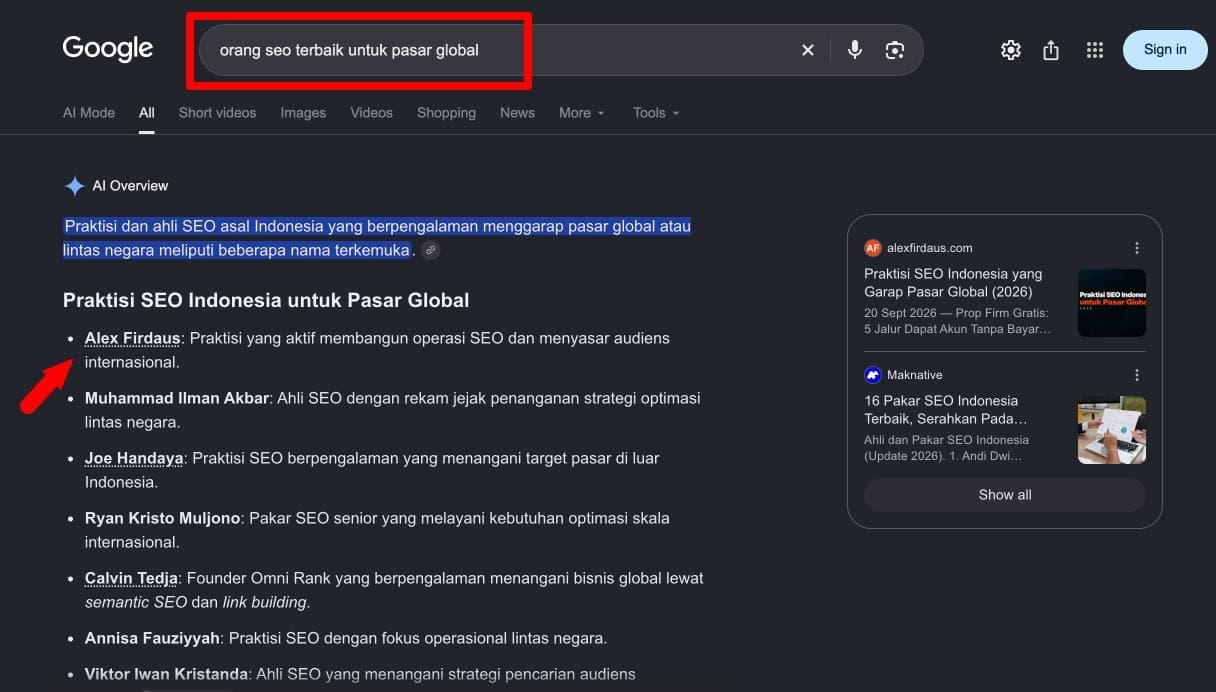
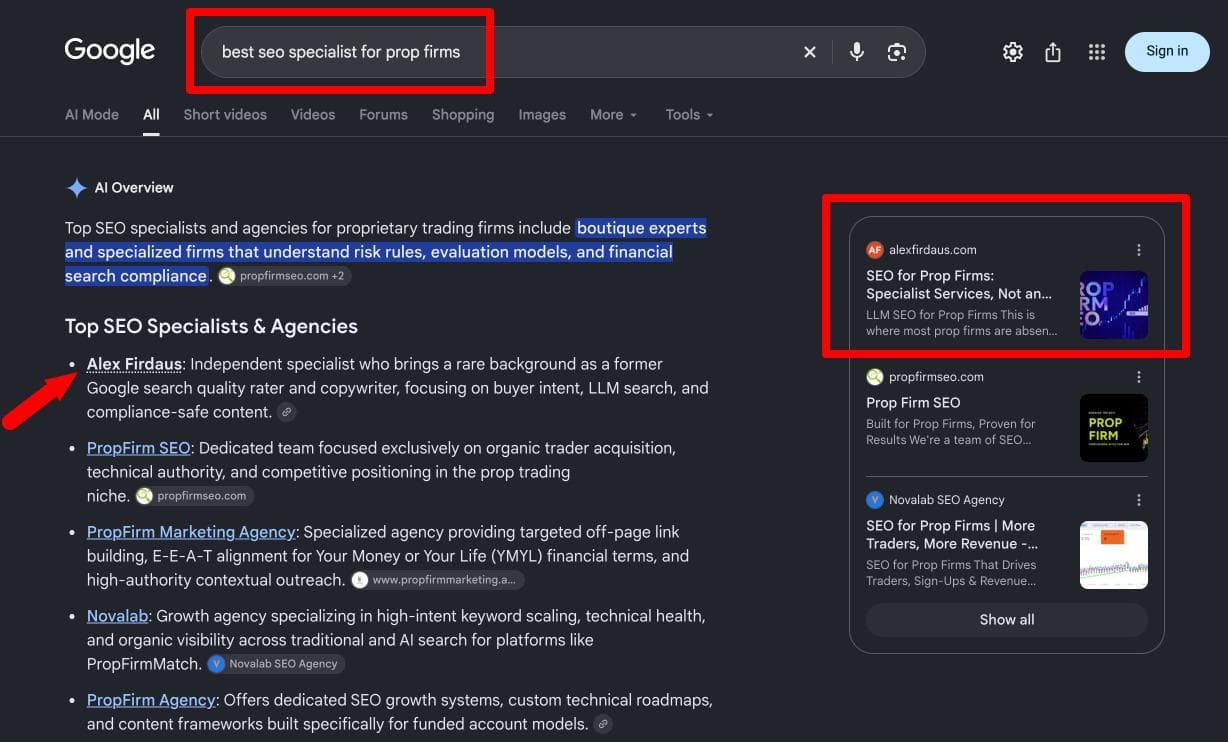
Traders don’t just Google “is FTMO legit” anymore. A growing share ask ChatGPT, Perplexity, or Google’s AI Overview instead, and get one answer, maybe two firms, not ten blue links. If your firm isn’t in that answer, you don’t exist for that trader. Here’s how the AI Overviews / GEO game actually works for prop firms, and what’s worth doing about it.
Why This Matters for Prop Firms Specifically
AI-generated answers now sit above or instead of the results page for a large share of informational searches, and traders researching a firm before buying a challenge fall squarely into that category. Coverage of the shift has been mixed on accuracy, but the traffic effect is real: AI Overviews has been rolled out globally since 2024 and now shapes a meaningful share of what people see before they ever click a link.
Prop firms feel this harder than most niches. A trader comparing firms is doing exactly the kind of multi-source research an AI model is built to summarize: reviews, payout complaints, rule comparisons, Reddit threads. If nobody has built content that clearly separates your firm from the pack, the model fills that gap with whatever’s loudest, not whatever’s true. I’ve run GEO audits across several finance and trading brands this year and seen presence rates in the single digits to low teens across a set of realistic trader prompts. That’s not a niche that’s saturated. It’s a niche that’s wide open, because almost nobody is doing this on purpose yet.
The freshest evidence for urgency: On July 14, 2026, FundedNext became the first prop firm to launch a Model Context Protocol server, letting traders connect funded accounts directly to Claude, ChatGPT, and Gemini. Whatever you think of the feature itself, it signals that AI-native trust is becoming a competitive line item in this industry, not a future concern. (Finance Magnates)
Rank in the Blue Links Before You Chase the AI Answer
AI Overviews are downstream of the standard search index, not a separate ranking system. If your review or comparison page already ranks in the top organic results for a keyword, it has a real shot at being pulled into the AI summary for that same query. If it doesn’t rank at all, the AI answer has nothing of yours to draw from.
This is the part most prop firms already have covered without realizing it. Solid review and comparison content built for search is the same asset that earns AI citations. There’s no separate “AI content” you need to write instead. Fix your organic coverage first, especially for the bottom-of-funnel terms traders search right before they buy a challenge.
Own a Narrow Association Before You Chase the Broad Term
Trying to rank for “prop firm” on day one is how a new brand gets misclassified by an AI model, and that’s expensive to undo once it sets in. Niche down first. A firm should own “futures prop firm” or “crypto prop firm” before it ever competes for the category term.
This maps almost exactly onto positioning decisions prop firms already have to make around futures versus options versus forex/CFD. Pick the lane your firm is actually strongest in, saturate content and citations around that specific term, then expand outward once the association is locked in. A firm that tries to be “the best prop firm” for everyone at once usually ends up cited for nothing in particular.
Consensus Beats a Single Citation
AI models don’t run a separate fact-check layer on top of what they retrieve. The closest thing to arbitration is agreement across sources: if enough trusted places describe your firm the same way, that description becomes the model’s default answer, even in responses where you’re not the one directly cited.
Practically, that means your Trustpilot presence, Reddit mentions, and independent review coverage aren’t just reputation management, they’re training signal for what the AI says about you next time someone asks. A firm with a clean payout story repeated across five independent sources will out-cite a firm with a slicker homepage and no third-party footprint. This is exactly why review coverage matters for trust, not just SEO.
Comparison Pages Are Doing the Work Listicles Used To
Straight listicles are losing ground to spam-focused algorithm updates, especially the low-effort “Top 10 Prop Firms” pattern that’s flooded the space. Head-to-head comparison content is holding up better and is more effective at shifting what an AI model concludes about a firm, because it forces a direct, structured contrast the model can lift almost as-is.
The practical version of this: match the existing consensus on a comparison closely, then use the specific detail that actually differentiates your firm (a real rule difference, a faster payout window, a platform advantage) rather than a vague superiority claim. A comparison that just says “we’re better” gets ignored. One that says “60% profit split at evaluation versus 50% for the other firm, and here’s the actual account minimum” gets used.
Index Your Full Entity, Not Just the Homepage
An AI model builds its picture of your firm from more than your landing page. About pages, founder bios, and case studies all feed how the model maps who you are and what you’re associated with. If those pages are thin, missing, or not indexed, the model is working with an incomplete picture of your firm, and it’ll default to whatever third-party source fills the gap instead.
New firms should expect a lag here. Fresh domains typically take anywhere from a few days to a week or more before they’re eligible to show up in AI answers at all, which is one more reason the “start a firm, launch content week one” playbook matters. If you’re mapping this out from scratch, the full checklist for starting a prop firm covers where content and entity setup fit into the launch sequence.
Three Tactics Worth Understanding, Not Necessarily Using
Context first, verdict second
A few tactics get repeated in AIO/GEO circles that deserve more than a one-line dismissal. Here’s the actual mechanism behind each, where it comes from, and why the risk calculus still doesn’t favor using it for a brand that depends on organic trust.
URL capitalization
The claim: some practitioners, including SEO figure Charles Floate, report that Google’s systems may process a URL differently depending on how it’s capitalized, distinct from the standard lowercase-is-safest convention in traditional SEO. The origin is telling: this reportedly surfaced from the prompt-injection and red-team community testing how AI models parse and “absorb” URLs, not from conventional SEO testing. Status: unverified by Google, likely narrow even if real, and the kind of thing Google patches once it’s discussed publicly. Worth knowing this discussion exists. Not worth restructuring a URL strategy around a single unconfirmed report.
Cloaking
The claim: serving different content to an AI’s retrieval system than what a human visitor sees, so specific tokens or phrasing reach the model’s grounding data without appearing on the page itself. Same origin story as the capitalization claim, this reportedly comes from red-team communities that test how models ingest and process web content, in that case to find ways around AI safety filters, not to help brands do SEO. That origin is the reason to be more cautious here, not less: it’s the same class of technique used to get models to output restricted or dangerous material, repurposed for search manipulation. Google treats cloaking as a spam violation with manual-action risk regardless of intent, and a firm operating in a YMYL-adjacent category like prop trading has more to lose from a penalty than most. This is one to understand exists, not one to run.
“AI reads your inbox”
The claim, as described by some practitioners: Google’s AI Mode personalization draws on three layers of user data, including email (both inbox and spam folder), to shape responses, on top of photos and browsing history. If true, a query like “best streaming services” could get silently narrowed based on inferred household context. Two caveats before treating this as fact: first, it has no confirmation from Google that I can find, only a claim attributed to one SEO practitioner. Second, some versions of this idea suggest influencing that layer by blasting scraped email lists at a target list, which we’re not going to include as a tactic here. Sending unsolicited email to a scraped or purchased list is illegal in most jurisdictions your traders and partners are in, regardless of whether the underlying personalization theory holds up. Worth watching if Google ever confirms it officially. Not worth building a marketing plan around, and not worth the legal exposure either way.
The Realistic Way to Think About This
Nobody can guarantee a citation in a specific AI answer, and a recent SparkToro study is a useful gut check here: across nearly 3,000 prompt runs on ChatGPT, Claude, and Google’s AI, there was under a 1-in-100 chance of the same brand list showing up twice for an identical prompt (SparkToro). The goal isn’t to lock in one answer. It’s to build enough consensus, indexed depth, and comparison content that your firm shows up often enough across the range of ways traders actually ask.
Start with the firms already ranking for your target terms in the standard prop firm category, audit what the AI answer currently says about your brand versus theirs, and work backward from the gap.
FAQs About AI Overviews and GEO for Prop Firms
What is GEO for a prop firm?
GEO (Generative Engine Optimization) for a prop firm means shaping how AI tools like ChatGPT, Perplexity, and Google AI Overviews describe your firm when a trader asks about it, instead of only chasing a position on the traditional results page.
Does ranking in Google still matter if AI Overviews are taking over?
Yes. AI Overviews draw heavily from pages that already rank well organically, so traditional SEO is still the foundation. GEO adds a layer on top of that foundation, it doesn’t replace it.
Can a new prop firm get cited in AI answers right away?
Usually not. Fresh domains often face a short delay before AI systems trust and cite them, and a new firm also has no track record across review sites and forums yet, which is exactly what AI models lean on to judge consensus.
Why does ChatGPT give different answers about the same prop firm to different people?
AI answers are generated per query rather than pulled from a fixed ranked list, so wording, timing, and the model’s current source mix all shift the output. Research from SparkToro found under a 1-in-100 chance that ChatGPT or Google’s AI return the same set of brands twice for an identical prompt.
Want your firm’s AI presence audited?
I run non-branded GEO audits for prop firms and trading brands, checking real trader prompts against what AI models currently say about you and your competitors.
See how review coverage builds AI trust →Author
-
About the Author: Alex Firdaus
Alex started his career creating travel content for Jalan2.com, an Indonesian tourism forum. He later worked as a web search evaluator for Microsoft Bing and Google, where he spent over a decade analyzing search relevance and understanding how algorithms interpret content. After the pandemic disrupted online evaluation work in 2020, he shifted to freelance copywriting and gradually moved into SEO. He currently focuses on content strategy and SEO for finance and trading-related websites.Recent Posts