Disclosure: I went through the QuantSentry demo and spent time inside the dashboard. This review is based on that first-hand experience and their public documentation.
Here is the thing about prop firm risk software: most of it is built around the wrong problem. It catches one trader breaking one rule in one account. Clean. Simple. Useless for the abuse that is actually hurting firms right now.
By 2025, firms were dealing with coordinated challenge-passing services, account farming, and signal mirroring that traditional rule-based enforcement simply could not catch. The firms that survived started investing in behavioral analysis at the network level, not just account-level dashboards.
QuantSentry is built for that specific problem. I went through the demo, spent time in the dashboard, and this is my honest take.
What is QuantSentry?
QuantSentry is a network-based fraud detection and risk platform built for proprietary trading firms. It finds hidden connections between traders, accounts, devices, and locations. Then it turns those connections into scored alerts and investigation evidence your risk team can actually use.
The key word is “network.” Most risk tools look at one account at a time. QuantSentry looks at all accounts at the same time and asks: which ones are behaving like they know each other?
This matters because coordinated trading abuse does not live in one account. It lives in the relationship between accounts. Copy rings. Hedge rings. One person running 30 accounts under different names. Groups buying challenges together and rotating who hits payout. None of that shows up cleanly in a single-account view. QuantSentry is built to find it at the network level.
It connects through read-only API access and works with MT5, cTrader, DXTrade, TradeLocker, ThinkTrader, MatchTrade, and Sirix. It also works without YourPropFirm CRM, if that is not your setup.
Who Actually Needs This?
QuantSentry is for prop firm operators, risk managers, and compliance teams. If you are on the trader side, this is not your product. If you are on the firm side and payout leakage keeps you up at night, keep reading.
Small firms think they can skip this. They usually cannot. When your entire risk operation is two people and a spreadsheet, one coordinated ring can extract five figures before anyone finishes typing “under review.” You do not have the buffer that scale gives you. Detection has to do more of the work.
If you are thinking about starting a prop firm, risk software is not the sexy line item in your budget. It is also the one that determines if there is a budget next year.
Larger firms have the opposite problem: too much noise. More traders means more alerts. More alerts means more manual reviews. More manual reviews means slower decisions and more human error. A risk tool that cannot prioritize is just creating a more expensive queue.
QuantSentry ranks alerts by fraud score so your team works the serious cases first. For small teams, that reduces load. For large operations, it reduces noise.
Seeing suspicious accounts?
QuantSentry helps prop firms see the network behind the account. Linked accounts, copied trades, hedging patterns, and organized abuse signals in one investigation workflow.
Book a QuantSentry demoHow QuantSentry Actually Works
Old risk tools work like checklists. Same IP? Flag it. Same open time? Flag it. Same lot size? Flag it. That catches the lazy ones. It does not catch the smart ones, and the smart ones are where the money goes.
Experienced abusers know how to offset trade timing by a few seconds, rotate lot sizes, use different devices, and split setups across platforms. Each account looks fine on its own. The problem only becomes visible when you look at the full behavioral pattern across all accounts at once.
QuantSentry analyzes around 130 variables per trade and maps those trades into vector space. Plain English: instead of checking one field at a time, it looks at the complete shape of how a trade was placed. Timing. Size. Direction. Sequence. Context. Then it compares that shape across every account in the system simultaneously.
When two accounts share a suspicious pattern, they get linked. When multiple accounts cluster around the same behavioral fingerprint, that cluster gets scored. Higher score means it surfaces earlier in your alert queue.
What QuantSentry Detects
QuantSentry covers the abuse types that are actually costing prop firms money right now. The point is not just to flag isolated rule breaks. The point is to find coordinated behavior across accounts.
Copy trading rings
One strategy multiplied across many accounts extracts payout at scale. Sophisticated setups offset timing and sizing to dodge basic checks.
Hedge trading rings
Accounts take opposing positions to move profit between them, often across different platform entities or firms.
Self-reverse hedging
One trader hedges against themselves across accounts to engineer a compliant payout path while each account looks clean individually.
Account fleets
One person runs many accounts under different identities to bypass per-account rules and stack payout surface.
Martingale behavior
Increasing position size after losses to force recovery. It looks aggressive on one account, but becomes clearer as a pattern across many.
Organized group trading
Networks buy challenges together, coordinate entries, and rotate who hits payout, sometimes across multiple firms.
HFT patterns
High-frequency activity that breaks firm rules or creates toxic flow problems with the liquidity provider.
If you want the full breakdown of the mechanics, I have a separate guide on how prop firm hedging abuse works.
Thresholds and factor weights are configurable per account stage. A challenge account and a funded account do not carry the same risk profile and should not be scored the same way. QuantSentry supports that separation.
The Dashboard and Investigation Workflow
This is where products that look good in a sales deck get separated from products that actually work on a Tuesday afternoon when your risk team has 40 open alerts and no patience.
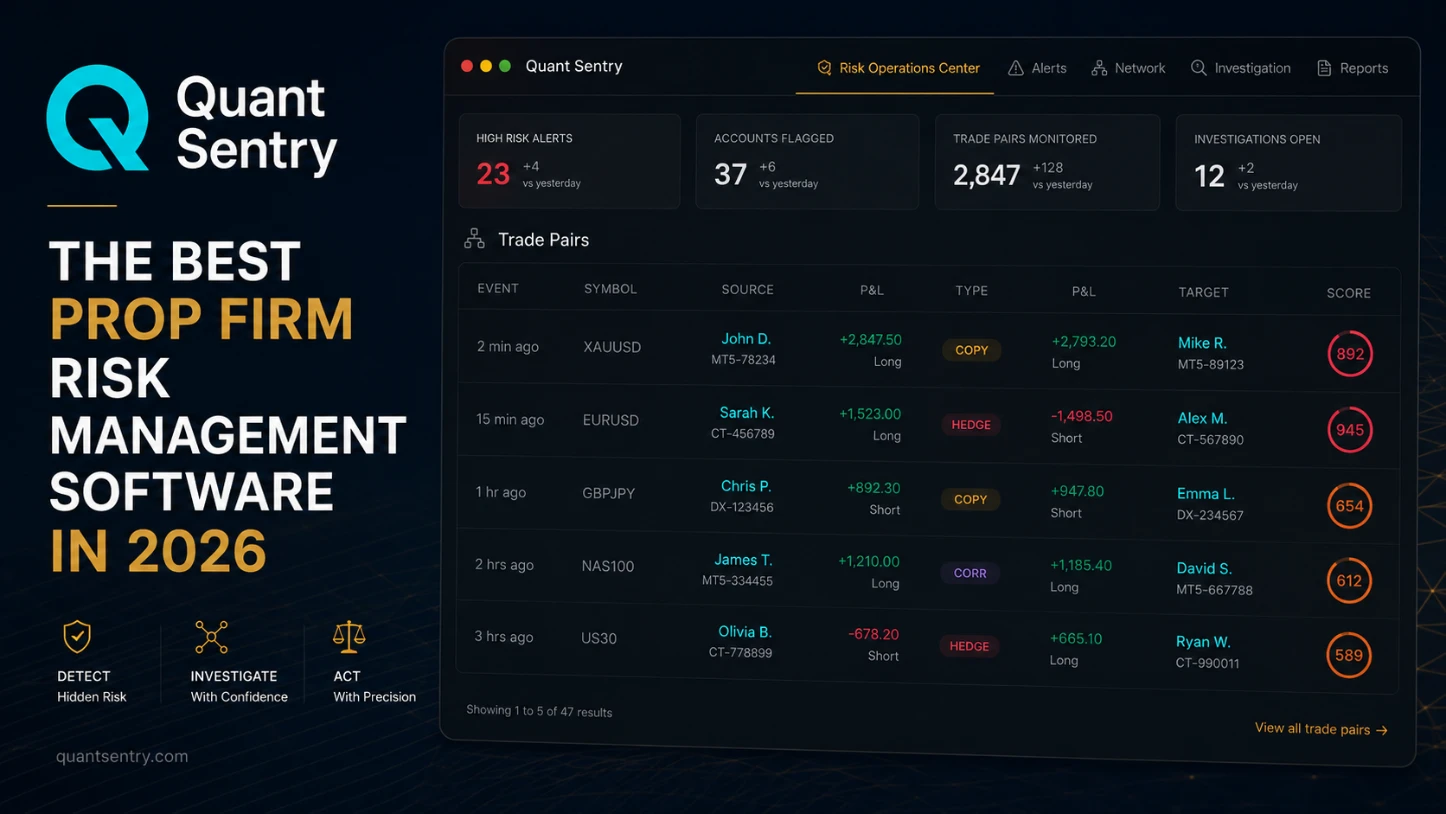
The dashboard is built around investigation, not just monitoring. Alerts come up ranked by fraud score with context already attached: trade details, network links, connected accounts, and the factors that drove the score. Your team is not starting from a blank flag. They are starting from a pre-built case.
Investigation views
Pulling up any trader opens a full investigation view. The network map shows which accounts are connected, how they are connected, and how strong each link is. A geo analysis layer adds location data to the picture, which helps tell the difference between two people sharing a device and two people sharing an operation.
Evidence kits
This is the feature operators underestimate until they need it. When a trader disputes a payout decision, a screenshot of a risk score is not going to hold up. QuantSentry organizes the evidence into a structured format: trade logs, network connections, score breakdown, audit trail. Something you can actually use to explain and defend the decision.
Prop firms have a trust problem with traders already. Weak evidence makes every enforcement call look like you made it up. Strong, organized evidence makes the case before the trader even escalates. There is also a real argument that unclear rule enforcement is one of the biggest reasons traders push back on legitimate decisions in the first place.
Workflow tracking and audit trails
Every action on every alert gets logged. Who reviewed it. What the decision was. When. That matters for internal accountability and for operating in any jurisdiction where enforcement decisions need a paper trail.
Note: AI-generated advisory PDF outputs were listed as a planned feature during the demo. Confirm current status directly with the team before factoring that into your decision.
Privacy Model and Data Handling
This is not a small detail. You are feeding trader behavior, account data, and potentially identity records into a third-party system. How that system handles data affects your regulatory exposure and your traders’ trust. In this industry, both matter more than people admit until something goes wrong.
- Identity-free operation. The platform can run without identity fields attached. Behavioral detection does not require names or emails to work.
- Read-only API access. QuantSentry connects through read-only manager API access. It cannot write to or modify your trading platform data.
- Internal-only by default. Nothing leaves your environment without explicit opt-in from you.
- Optional cross-firm network. You can opt in to share anonymized behavioral fingerprints and risk scores with other firms. Not names. Not emails. Not account identifiers. Just the signal.
The opt-in model is the right call. Sharing raw trader identity across competing firms would be a legal mess. Sharing anonymized behavioral signals, “this trading pattern has been flagged across three other firms,” adds real detection value without the exposure.
QuantSentry vs Axcera RiskGuard vs Centroid PropShield
These are the three serious products in prop firm risk management right now. They are not the same thing. Picking the wrong one for your situation is an expensive lesson.
QuantSentry vs Axcera RiskGuard
Axcera RiskGuard leads with threat-profile intelligence. A database of known bad actors, real-time exposure monitoring, broad rule enforcement. It calls itself “the antivirus for prop firms” and lists 10,000+ verified threat profiles across 50+ firms. That is a credible pitch if you want broad coverage and want bad-actor identification partly managed by a shared database.
The difference is what each product is built to do well. Axcera is built for broad monitoring and threat intelligence. QuantSentry is built for coordinated abuse detection, investigation quality, and defensible enforcement. If your main problem is copy rings and hedge rings slipping through basic checks, QuantSentry is the sharper tool. If your main problem is overall risk visibility and known bad-actor coverage, Axcera makes more sense.
QuantSentry vs Centroid PropShield
Centroid PropShield is a different kind of comparison. Their infrastructure offering is serious: real-time exposure monitoring, client PnL analysis, liquidity and bridge infrastructure, hosting, execution. PropShield sits inside that suite and adds shared intelligence across the Centroid network.
If you are already deep in Centroid’s stack, PropShield makes sense as an extra layer. If you are evaluating risk software on its own, QuantSentry is the more focused product for coordinated abuse. Centroid’s center of gravity is broker infrastructure. QuantSentry’s is prop firm fraud investigation. Those are different problems.
| Dimension | QuantSentry | Axcera RiskGuard | Centroid PropShield |
|---|---|---|---|
| Primary focus | Coordinated abuse detection and investigation quality | Broad monitoring and threat-profile intelligence | Shared intelligence within Centroid infrastructure |
| Network-level detection | Core product feature | Partial, via bad-actor database and behavioral monitoring | Via PropShield cross-firm network |
| Evidence kits for disputes | Yes, built into the investigation workflow | Not prominently featured | Not prominently featured |
| Explainable scoring | Yes, configurable factor weights | Limited public detail | Limited public detail |
| Standalone product | Yes, works without YourPropFirm CRM | Yes, standalone or within Axcera | Works best inside Centroid stack |
| Privacy model | Identity-free option, read-only API, opt-in network | Not detailed publicly | Anonymous signals via PropShield |
| Published pricing | Yes, tiered and public | Demo-gated | Demo-gated |
| Best fit | Firms whose main risk is coordinated abuse and payout disputes | Firms wanting broad monitoring and bad-actor database coverage | Firms already committed to Centroid infrastructure |
What Works and What to Watch
What works
- Network-level detection built for how abuse actually operates in 2026
- 130+ variables per trade analyzed, not a checklist
- Alerts ranked by fraud score with full context, not just a flag
- Evidence kits built for payout disputes and enforcement decisions
- Configurable thresholds per account stage
- Read-only API, so it cannot touch your platform data
- Opt-in intelligence network shares signals, not identity
- Pricing is public, so you do not need a demo just to see a number
- Structured onboarding with a 30-day tuning cycle
What to watch
- Relatively new in market with limited third-party validation from live firms
- Cross-firm intelligence network value depends on how many firms actually opt in
- Requires proper tuning to get full value, so it is not plug-and-play out of the box
You do not just need another alert dashboard.
You need to see which accounts are connected, why they were flagged, and what evidence supports the decision. That is the real QuantSentry use case.
See the QuantSentry workflowQuestions to Ask Before You Sign
Ask about their sandbox environment
The general demo gives you a good feel for the product. Ask if they can walk you through scenarios that match your firm’s specific risk profile: your platform, your account types, your typical abuse patterns.
Alert-to-decision timeline
Ask how long it takes the average risk team to move from alert to enforcement decision after the tuning period. That number tells you more than any feature list.
False positive rate at your scale
High detection sensitivity without good precision just creates work. Ask what false positive rates look like at a firm similar in size to yours.
Integration specifics for your setup
General platform support is listed. If you are running a white-label configuration or a non-standard platform version, confirm the exact integration path before committing.
Intelligence network opt-in detail
Understand exactly what gets shared, under what conditions, and how you can audit your own participation. Anonymous is a spectrum. Find out where on it they sit.
AI advisory PDF feature status
This was listed as a coming feature during the demo. Confirm whether it is live, in beta, or still on the roadmap before you factor it into your decision.
Final Verdict
Between 2024 and 2025, dozens of prop firms shut down. Not all of them failed because of fraud. But many firms that did fail had weak risk controls that let abuse go undetected long enough to do serious damage.
QuantSentry is the most purpose-built prop firm risk product I have reviewed for the problems operators are actually facing in 2026. It understands that abuse is networked, investigation backlogs are real, and enforcement decisions need evidence behind them. That is a more honest product brief than most of what this category has been selling.
Axcera RiskGuard is the stronger choice if you want broad threat-profile intelligence and wide monitoring coverage. Centroid PropShield makes sense if you are already running on Centroid infrastructure. But if the question is coordinated abuse detection, payout protection, and investigation quality, QuantSentry is where I would start the shortlist.
Risk is not the interesting part of running a prop firm. It is the part that decides whether the firm is still running next year. At some point, the two things are the same.
QuantSentry
Seeing suspicious accounts? You need to see the network. QuantSentry is purpose-built detection for prop firms: linked accounts, copied trades, hedging patterns, and coordinated abuse in one workflow.
Book a QuantSentry demoFrequently Asked Questions
Is QuantSentry better than Axcera RiskGuard?
For coordinated abuse detection, network analysis, and investigation evidence quality, yes. Axcera RiskGuard is stronger if your priority is broad threat-profile monitoring and bad-actor database coverage. The right answer depends on which problem you are actually trying to solve.
Is QuantSentry better than Centroid PropShield?
For prop firm fraud detection as a standalone priority, yes. Centroid PropShield is strongest as part of a broader Centroid infrastructure relationship. If you are not already in the Centroid ecosystem, QuantSentry is the more focused choice for coordinated abuse and payout protection.
Does QuantSentry detect copy trading rings?
Yes. Copy trading ring detection is one of QuantSentry’s core detection areas. It analyzes behavioral patterns across accounts to identify coordinated copying, including setups that offset timing or lot size to avoid basic rule checks.
Does QuantSentry detect hedge abuse?
Yes. It includes hedge trading ring detection and self-reverse hedging detection. You can read my full guide on how prop firm hedging abuse works if you want the mechanics explained.
Does QuantSentry share trader data with other firms?
The optional intelligence network shares anonymized behavioral fingerprints and risk scores, not names, emails, or full account records. Participation is opt-in and internal-only mode is the default.
Does QuantSentry work without YourPropFirm CRM?
Yes. It works as a standalone product and integrates directly with trading platforms via read-only API access. YourPropFirm CRM is compatible but not required.
Is QuantSentry only for large prop firms?
No. Small firms arguably need it more. Fewer people reviewing accounts means more room for a coordinated ring to go undetected long enough to actually hurt the business. Published pricing tiers make it accessible at different scales.
What trading platforms does QuantSentry support?
Based on their documentation: MT5, cTrader, DXTrade, TradeLocker, ThinkTrader, MatchTrade, and Sirix. Confirm your specific platform configuration with the team before committing.
How long does QuantSentry take to set up?
Their onboarding process includes a 30-day tuning cycle aligned to your firm’s rulebook. They say most firms see first value within the first week. That will depend on your platform setup and data quality going in.