The Pattern I Keep Seeing In Prop Firm Provider Marketing
There is a problem I keep seeing in ads for prop firm providers, the companies that sell the tech, tools, and infrastructure that help someone launch and run a prop firm.
And the problem is simple.
Most marketing accidentally talks to traders.
That is weird, because traders are not the buyer.
If you are a prop firm provider, your customer is the person building the prop firm. The founder. The operator. The educator with a community who wants to monetize. The broker or brokerage team looking to add a funded program. The business minded person trying to launch an offer.
But a lot of campaigns do not act like that.
They buy keywords that attract traders.
They run ads that attract trader curiosity.
They send that traffic to a “book a demo” page and wonder why conversion is trash.
Then the usual blame game starts.
Meta sends low quality traffic.
Google is too expensive.
The creative is not working.
The market is saturated.
Most of the time, the platforms are not the issue.
The issue is that the ads are not clear about who they are for.
A trader sees “prop firm” and clicks because that is their world.
A founder sees “prop firm” and clicks because they want to build a business.
Those are two completely different people with two completely different goals, and if your marketing treats them the same, your results will look active but your pipeline will stay empty.
That is the pattern.
Lots of attention.
Lots of clicks.
Very few real conversations with actual builders.
And it usually comes down to one mistake, confusing trader intent with operator intent.
Not All Clicks Mean The Same Thing
One of the most misleading metrics in prop firm provider marketing is CTR.
Click through rate looks objective. It looks scientific. It feels like progress.
And that is exactly why it causes so much confusion.
Because a click does not tell you why someone clicked.
Someone can click because they want to buy.
Someone can click because they are curious.
Someone can click because they misunderstood what the ad was about.
Someone can click because it looked interesting for half a second.
Those clicks all look identical in your dashboard.
They are not identical in real life.
This matters a lot more for prop firm providers than for many other businesses.
Why
Because the word “prop firm” attracts two completely different worlds.
One world is traders.
The other world is builders.
A trader clicks because they think:
“Is this a new firm I can get funded with?”
A builder clicks because they think:
“Can this help me launch my own firm?”
Same click. Totally different intent.
Now here is where things go wrong.
Most campaigns celebrate the click without asking the harder question:
“What was the person actually trying to do when they clicked?”
This is how you end up with reports that look busy but produce nothing meaningful.
High impressions.
Good CTR.
Low or zero serious leads.
At that point, teams start optimizing the wrong thing.
They try to increase CTR even more.
They tweak creatives to be more eye catching.
They adjust targeting, placements, and budgets.
But if the clicks are coming from the wrong mindset, making them cheaper or more frequent just scales the problem.
This is why “good CTR” can be a red flag in this niche.
If your ads about building a prop firm are pulling in large volumes of clicks but very few conversations with founders, operators, or educators, the issue is not traffic quality in general.
It is intent mismatch.
You are attracting attention from people who were never going to become customers in the first place.
And no amount of creative testing or algorithm tuning fixes that.
The fix starts with understanding what someone is thinking when they click, not just celebrating the fact that they did.
Who Prop Firm Providers Are Actually Selling To
This is the part where most people get it wrong, even people working inside the industry.
If you are a prop firm provider, you are not selling to traders.
You are selling to people who want to build or operate a prop firm.
That sounds obvious when you say it out loud. In practice, marketing often ignores it.
Let’s be very clear about who the real buyers are.
First, there are founders and operators.
These are people who already decided they want to launch a prop firm, or they are running one and looking to upgrade their setup. They care about things like reliability, risk rules, payouts, fraud prevention, and how fast they can launch without everything breaking.
Second, there are educators and influencers with trading communities.
They already have attention. They want monetization. They are thinking in terms of branding, white labeling, revenue splits, and not having to build infrastructure from scratch.
Third, there are brokers and broker adjacent businesses.
Some want to add a funded program. Some want a parallel brand. Some want a way to acquire or retain traders. They care about integrations, compliance posture, and operational control.
There are other edge cases, fintech entrepreneurs, partners, referral driven operators, but they all share one thing.
They are thinking like business builders.
Now compare that mindset to a trader’s mindset.
A trader is thinking about:
- Passing a challenge
- Getting funded
- Payout rules
- Drawdown limits
A builder is thinking about:
- Business model
- Risk exposure
- Systems
- Scale
- Operations
Those two mindsets are not even in the same universe.
And yet, a lot of prop firm provider marketing treats them as if they are interchangeable.
That is how you end up with ads that attract attention from traders and then feel confused when none of those clicks turn into serious conversations.
From the platform’s point of view, the campaign is working. People are clicking.
From the business point of view, nothing is happening.
The core issue is not reach or targeting.
It is that the messaging does not clearly signal who this is for.
If a trader clicks your ad and thinks, “Oh, this is not for me,” that is not a failure. That is a win.
The real failure is when traders keep clicking, founders do not recognize themselves, and everyone walks away unhappy.
Once you understand who you are actually selling to, the rest of the article becomes obvious. Keywords, creatives, and landing pages stop being tactical decisions and start being filtering mechanisms.
And that is where most prop firm provider marketing needs to change.
The Three Mindsets Behind Prop Firm Related Searches And Clicks
This is where most prop firm provider marketing quietly breaks.
People see a keyword or an ad and assume it represents one type of person. In reality, the same words attract very different mindsets.
When someone searches or clicks on something related to prop firms, they usually fall into one of three buckets.
Mindset one. “I want to build a prop firm now”
This person is the gold standard.
They have already crossed the hardest mental hurdle. They are not asking if this is possible. They are asking how to do it properly.
What they are thinking:
“I want to launch or run a prop firm and I need software, systems, or infrastructure.”
What they search for:
- prop firm platform
- prop firm software
- white label prop firm
- prop firm risk management software
- prop firm payout system
These people are not browsing. They are shopping.
When someone like this clicks an ad, sending them to a vague page or a generic “get in touch” form is a waste. They want clarity. What you do, who it is for, and what happens next.
This is where direct demo and sales pages actually work.
Mindset two. “I know this space, but I am still evaluating”
This person is aware but cautious.
They know prop firms exist. They know there are providers. They just do not know who to trust or how things really work behind the scenes.
What they are thinking:
“Who are the real players here and what is the difference between them?”
What they search for:
- best prop firm platform
- fpfx alternatives
- prop firm tech stack
- yourpropfirm vs fpfx
These people are not ready to be sold aggressively. They are trying to orient themselves.
This is where most providers mess up.
Instead of helping this person understand if they are a good fit, they push them straight into a sales call. The result is predictable. The person bounces, or books a call and ghosts.
What this mindset needs is filtering and clarity, not pressure.
Mindset three. “I am just trying to understand this world”
This is the biggest bucket by volume and the most dangerous one if you treat it wrong.
What they are thinking:
“I have heard about prop firms. How does this even work?”
What they search for:
- how to start a prop firm
- how to start a futures prop firm
- how to start a crypto prop firm
- prop firm business model
- how do prop firms make money
These searches produce a lot of impressions and a lot of clicks.
They do not produce buyers.
At least not yet.
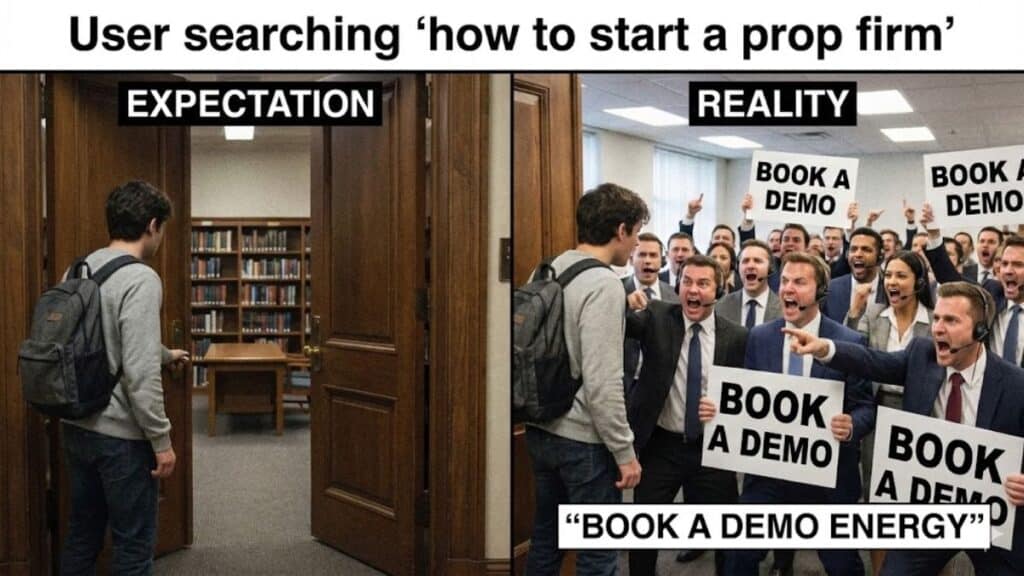
This traffic is not bad. It is just early. These people are learning, exploring, and sometimes daydreaming. If you send them to a sales page and ask them to book a call, most of them will leave immediately.
That is not because your product is bad. It is because the ask does not match their mindset.
This is where many reports show high click through rates and zero real leads, and everyone wonders what went wrong.
Nothing went wrong. The traffic behaved exactly as expected.
The real mistake is treating these three mindsets as if they are the same person.
They are not.
When you send all of them to the same page and ask them to do the same thing, your data becomes noisy, your pipeline dries up, and you start blaming platforms and creatives for a problem that starts much earlier.
The Mistake Almost Everyone Makes
Once you understand those three mindsets, the most common mistake in prop firm provider marketing becomes obvious.
Almost everyone treats them as the same person.
Different searches.
Different reasons for clicking.
Same landing page.
Same call to action.
Usually something like “Book a demo” or “Get in touch.”
On paper, this looks efficient. One page. One funnel. One goal.
In reality, it is a conversion killer.
Someone who is ready to build a prop firm can handle a sales conversation.
Someone who is comparing options wants context first.
Someone who is still learning does not want to talk to anyone at all.
When all three are sent to the same page, here is what happens.
The buyers feel the page is vague and generic.
The evaluators feel rushed and pressured.
The learners feel confused and leave.
So you end up with traffic, but no momentum.
This is also why teams often misread their own data.
They see high click volume and assume the ads are working.
They see low conversion rates and assume the platform is broken.
They tweak budgets and creatives instead of questioning the structure.
But the structure is the problem.
This mistake is especially common in prop firm providers because the industry overlaps with trading. The word “prop firm” pulls in attention from people who were never meant to be customers.
If your funnel does not actively separate those people, your ads will do it for you, by burning budget.
The uncomfortable truth is this.
If your landing page does not clearly say who it is for and who it is not for, your ads will always attract the wrong mix of people.
And no amount of optimization can fix that.
Why Creatives Get Blamed When The Funnel Is Actually Broken
When campaigns do not produce results, creatives are usually the first thing people point at.
“The creatives are not strong enough.”
“We need more hooks.”
“The ads are not eye catching.”
Sometimes that is true. Often, it is not.
In prop firm provider marketing, creatives usually fail for a different reason.
They work too well.
A good creative is supposed to stop the scroll and earn a click. On platforms like Meta especially, that is the whole first job. And many prop firm provider ads do that part just fine.
The problem starts after the click.
If a creative sparks curiosity but the page assumes buying intent, the user experiences whiplash. They clicked because they were interested, not because they were ready to talk to sales.
From the advertiser’s point of view, it looks like this:
- High impressions
- Healthy CTR
- No meaningful leads
So the conclusion becomes, “the creative is attracting the wrong people.”
That is only half true.
The creative is attracting attention.
The funnel is failing to filter that attention.
In this space, creatives should not just attract. They should also signal.
They should quietly answer two questions before the click happens:
- Who is this for
- Who is this not for
When creatives are vague, they invite everyone. Traders, learners, builders, and curious bystanders all click. The platform thinks it is doing a great job. The business does not.
This is why simply making creatives more eye catching often makes performance worse. You get more clicks from people who were never meant to convert.
A strong creative in this niche does not just say “start a prop firm.”
It says “start a prop firm if you are the kind of person who should.”
When that filtering does not happen in the creative or the page, creatives take the blame for a structural problem they did not create.
Meta And Google Are Not The Same Game
One of the quiet mistakes prop firm providers make is treating Meta and Google like interchangeable traffic sources.
They are not.
Same product. Same offer. Very different psychology.
When someone clicks a Google ad, they are usually doing it on purpose. They typed something into a search bar because they want an answer. There is intent baked in before your ad even shows.
When someone clicks a Meta ad, they were not looking for you. They were scrolling, half bored, half distracted, probably avoiding something else they should be doing.
That difference matters.
Google traffic asks, “Can you solve this problem I already know I have?”
Meta traffic asks, “Why should I care about this right now?”
So the role of creative and messaging changes.
On Google, clarity wins.
Literal language wins.
Being boring but precise often outperforms being clever.
If someone searches “prop firm software,” they do not need to be entertained. They need confirmation that you do the thing they are looking for.
On Meta, clarity alone is not enough.
You first have to earn attention.
Then you have to give context.
Then you have to qualify.
This is where a lot of campaigns fall apart.
They use Google style thinking on Meta. Feature lists. Dashboards. Generic SaaS language. It looks professional, but it does not stop the scroll or frame the offer clearly enough.
Or they swing the other way.
They use very broad Meta hooks like “Start your own prop firm” without clarifying who it is for. That stops the scroll, but it attracts everyone. Traders, learners, dreamers, and only a small number of actual builders.
Both approaches create the same outcome. Clicks without substance.
The real mistake is not using Meta or Google incorrectly. It is using the same message, the same page, and the same call to action on both.
When that happens, Google traffic feels under served and Meta traffic feels rushed.
Different platforms require different conversations.
Once you accept that, performance stops being mysterious and starts being predictable.
What A Better Structure Actually Looks Like
Once you stop treating all clicks the same, the fix is not complicated.
It is mostly common sense that gets lost once ads, dashboards, and platforms enter the picture.
A better structure starts with one simple rule.
Different mindsets need different next steps.
That is it.
People who are ready to build a prop firm should be allowed to move fast.
People who are comparing options should be helped to orient themselves.
People who are still learning should not be pushed into a sales conversation they never asked for.
In practice, this means three different paths.
Learning focused searches and broad Meta curiosity traffic should go to education.
Guides. Checklists. Clear explanations. Something that helps them understand the business side of prop firms without pressure.
Comparison focused searches should go to pages that explain what you do, who it is for, and who it is not for. These pages are not about hype. They are about clarity and fit.
High intent searches should go straight to a sales or demo page. These people are already asking for a solution. Making them jump through extra hoops only slows things down.
Notice what this structure does.
It does not try to force everyone to convert at the same speed.
It does not rely on clever tricks or aggressive copy.
It lets people self select based on where they are mentally.
This also makes your data easier to read.
When learning traffic does not convert to demos, that is expected.
When high intent traffic does not convert, that is a real problem.
When comparison traffic bounces, your positioning is unclear.
Without this separation, everything blends together. You see clicks, impressions, and CTR, but you have no idea what is actually working.
Most prop firm provider marketing fails not because it lacks complexity, but because it lacks structure.
Once the structure is right, optimization becomes much simpler and far less emotional.
Why This Problem Is Worse For Prop Firm Providers Than Most Industries
Every industry has intent mismatch problems. Prop firm providers feel it more than most.
The reason is structural.
Prop firms sit at the intersection of trading and business. That creates constant confusion about who the product is actually for.
To a trader, a prop firm is a place to trade.
To a builder, a prop firm is a business model.
Both groups use the same words.
Both groups click the same ads.
Only one group is ever going to buy prop firm infrastructure.
That overlap makes marketing deceptively hard.
In a normal SaaS category, the buyer and the user are usually aligned. A CRM is marketed to sales teams. Accounting software is marketed to finance teams. The language filters naturally.
Prop firm providers do not get that luxury.
The word “prop firm” pulls in traders automatically. Platforms do not know the difference. Algorithms do not care. They optimize for engagement, not business viability.
If your marketing does not actively separate traders from operators, the platforms will happily mix them together for you.
There is also a second layer of pressure.
Financial and trading adjacent advertising is heavily scrutinized. Platforms are sensitive to misleading claims, and funnels that generate high click volume with low downstream action often get flagged faster than in other niches.
That means sloppy structure is not just inefficient. It is risky.
High curiosity traffic with no conversion does not just waste spend. It sends negative signals back to the platform that something is off, which can hurt delivery over time.
This is why prop firm providers feel like ads “stop working” faster than expected. It is not always fatigue. Sometimes it is the algorithm learning that people click, then leave.
When intent, messaging, and next step are aligned, this pressure eases. Traffic behaves more predictably. Leads make more sense. And performance stops feeling random.
The Real Takeaway
Most prop firm provider ads do not fail because of bad platforms, bad creatives, or bad targeting.
They fail because the thinking is backwards.
Teams focus on tactics first. Keywords, hooks, formats, budgets. All of that comes before answering a much simpler question.
“What is this person actually trying to do right now?”
When that question is ignored, everything downstream breaks.
Clicks look like success.
CTR looks like progress.
Dashboards look busy.
But the pipeline stays thin.
Prop firm providers sit in a unique position. The same words attract traders, learners, and business builders. If your marketing does not clearly separate those mindsets, the platforms will not do it for you.
Good marketing in this space is not about squeezing more performance out of the algorithm.
It is about matching:
- The mindset behind the click
- The message in the ad
- The next step on the page
When those three align, ads feel almost boring in how predictable they become.
When they do not, no amount of creative testing or optimization will save you.
The uncomfortable truth is this.
Most prop firm provider marketing does not need better hacks.
It needs better intent discipline.
Once you get that right, everything else, creatives, platforms, budgets, starts to work the way people expect it to.
And that is usually the moment when ads stop feeling like a constant fight and start behaving like a system.